
EN 55035, “Electromagnetic compatibility of multimedia equipment – Immunity requirements”, sets how well information technology, audio, video and broadcast receiver equipment must withstand electromagnetic disturbance from outside. Immunity is the ability to keep working under effects such as static discharge, mains transients or radio transmitters. It replaced EN 55024 and EN 55020, and in EMC testing it is applied together with the emission standard EN 55032.
Let us take care of EN 55035 testing and the CE marking of your product together; CE Danışmanı (CE Consultant) manages the whole process.
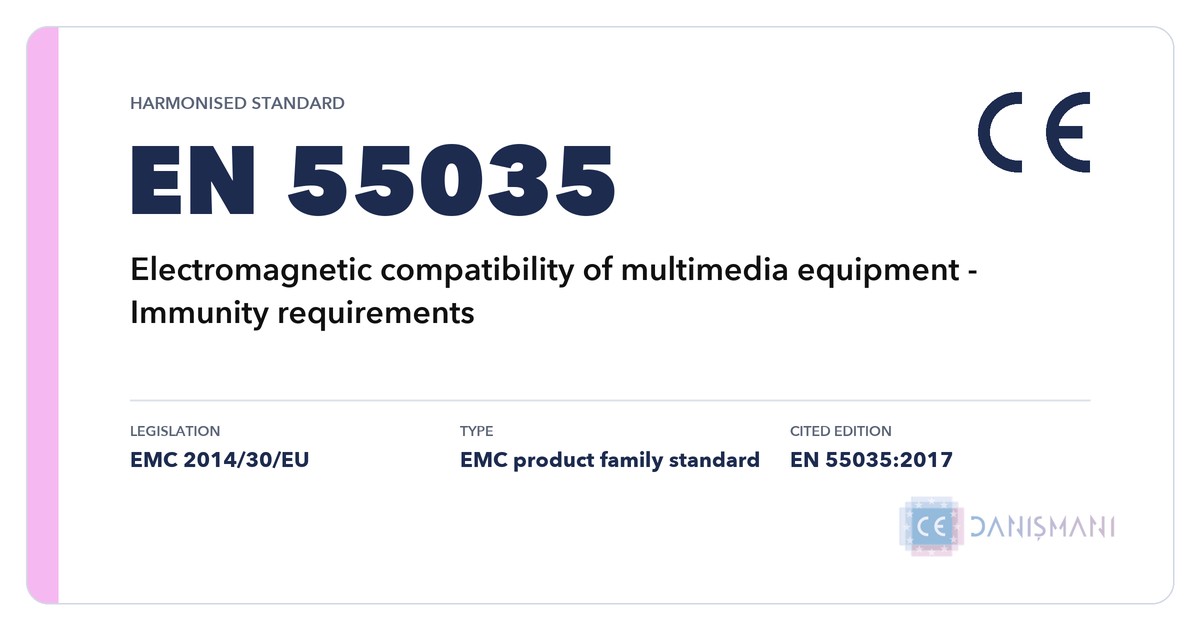
EN 55035 at a glance
| Edition cited in the EU Official Journal | EN 55035:2017 |
|---|---|
| Official title | Electromagnetic compatibility of multimedia equipment – Immunity requirements |
| Legislation supported | EMC Directive 2014/30/EU |
| Type of standard | EMC product family standard |
Products covered
The standard covers the same product family as EN 55032, that is multimedia equipment. Typical examples:
- Computers, servers, monitors and peripherals
- Printers, scanners and multifunction office devices
- Modems, routers and other network equipment
- Televisions, satellite receivers, media players
- Audio systems and professional audio and video equipment
- Point-of-sale terminals and kiosks
Immunity of household appliances is covered by EN 55014-2 and that of lighting equipment by EN 61547. For equipment used in industrial environments without a product standard, the generic immunity standard EN IEC 61000-6-2 applies.
Main requirements of the standard
- Testing by port: Disturbances are applied separately to the enclosure, to signal and network ports, to the DC power port and to the AC mains port.
- Performance criteria: Criterion A, B or C is set for each test: uninterrupted operation during the test, self-recovery after a temporary disturbance, or recovery by user action.
- Function-based assessment: What is acceptable is defined for each function, such as printing, scanning, display, audio output, networking and broadcast reception.
- Immunity to continuous disturbances: The function of the equipment is monitored under radiated and conducted radio-frequency disturbance.
- Immunity to transients: Resistance to short events such as electrostatic discharge, fast transients and surges is verified.
- Mains quality events: The behaviour of the equipment during voltage dips and short interruptions is assessed.
- Test specific to xDSL ports: Immunity to broadband impulse noise is defined separately for these ports.
EN 55035 tests
The tests use the methods of the basic EMC standards in the EN 61000-4 series. EN 55035 states which test is applied to which port.
| Test or check | What is verified? |
|---|---|
| Electrostatic discharge (EN 61000-4-2) | The equipment is unaffected by, or recovers from, contact and air discharges to surfaces the user touches |
| Radiated RF electromagnetic field (EN 61000-4-3) | The equipment keeps working in the field of nearby transmitters |
| Electrical fast transient / burst (EN 61000-4-4) | Resistance to switching transients on power and signal lines |
| Surge (EN 61000-4-5) | Resistance to surges caused by lightning and mains switching |
| Conducted disturbances induced by RF fields (EN 61000-4-6) | Resistance to radio-frequency disturbance arriving through cables |
| Power-frequency magnetic field (EN 61000-4-8) | Equipment with magnetically sensitive components is unaffected |
| Voltage dips and short interruptions (EN 61000-4-11) | Behaviour during short drops and interruptions of the mains |
Its place in CE marking
- EMC assessment: The environment, the ports and the applicable emission and immunity standards are identified.
- Design: Input protection, filtering, shielding and the error recovery behaviour of the software are designed with the immunity tests in mind.
- Testing: Immunity is tested to EN 55035 and emission to EN 55032.
- Technical file: The test report, set-up photographs and diagrams go into the technical file.
- Declaration of conformity: EN 55035 is listed among the standards applied and the CE marking is affixed.
Conformity with a harmonised standard gives presumption of conformity with the corresponding essential requirements of the EMC Directive 2014/30/EU. The safety side of mains-powered multimedia equipment is assessed with EN 62368-1.
Standards applied together
- EN 55032: Emission of multimedia equipment
- EN 62368-1: Safety of audio/video and ICT equipment
- EN 61000-4 series: Basic immunity test methods
- EN IEC 61000-3-2 and EN 61000-3-3: Harmonic current and flicker
- EN 55014-1: Emission of household appliances
Frequently asked questions
What do performance criteria A, B and C mean?
Under criterion A the equipment works as intended during and after the test. Under B a temporary disturbance is allowed during the test but the equipment recovers by itself. Under C loss of function is allowed and the equipment works again after user action.
Is my EN 55024 report still valid?
EN 55024 has been withdrawn and replaced by EN 55035. For a new declaration of conformity the product should be assessed to EN 55035.
Which edition applies?
The edition cited in the EU Official Journal under the EMC Directive is EN 55035:2017. Check the current citation before testing starts.
Other standards in this group
- EN 55014-1: EMC Emission of Household Appliances
- EN 55032: EMC Emission of Multimedia Equipment
- EN 55011: RF Disturbance of Industrial Equipment
- EN 55015: Radio Disturbance of Lighting Equipment

