
Medical Device Testing for CE Marking
October 1, 2026
EN ISO 13849-1: Performance Level and Categories
October 1, 2026

EN ISO 12100, “Safety of machinery – General principles for design – Risk assessment and risk reduction”, is the basic safety standard for machinery. It describes how the hazards of a machine are identified, how the risks are estimated and evaluated, and in which order they are reduced. Every machine placed on the EU or Turkish market with a CE marking must have a documented risk assessment, and EN ISO 12100 is the method used for it.
For an EN ISO 12100 risk assessment and CE marking of your machine, apply to CE Danışmanı (CE Consultant); we manage the whole process for you.
EN ISO 12100 at a glance
| Edition cited in the EU Official Journal | EN ISO 12100:2010 |
|---|---|
| Official title | Safety of machinery – General principles for design – Risk assessment and risk reduction (ISO 12100:2010) |
| Legislation supported | Machinery Directive 2006/42/EC; from 20 January 2027 Regulation (EU) 2023/1230 |
| Type of standard | Type A (basic safety standard that applies to all machinery) |
| Standards it replaced | EN ISO 12100-1, EN ISO 12100-2 and EN ISO 14121-1 |
| In Turkey | Published as TS EN ISO 12100 and applied under the Machinery Safety Regulation |
Why a risk assessment is required
The Machinery Directive requires the manufacturer to carry out a risk assessment in order to determine the health and safety requirements that apply to the machine. The machine is then designed and built taking the results into account. The documentation of the assessment is a mandatory part of the technical file.
The order matters: the risk assessment is done at the design stage, not after CE marking. The CE marking and the EU Declaration of Conformity are the result of this work. A technical file without a risk assessment is incomplete, and market surveillance authorities treat it as a non-conformity.
The standard itself is voluntary, but EN ISO 12100 is the established method for the risk assessment the legislation asks for.
Type A, B and C standards
Machinery safety standards form three layers. EN ISO 12100 sits at the top and gives the method the others rely on.
| Type | Scope | Examples |
|---|---|---|
| Type A | Basic concepts and design principles for all machinery | EN ISO 12100 |
| Type B | One safety aspect or one type of safeguard used across many machines | EN ISO 13849-1, EN ISO 13857, EN 60204-1 |
| Type C | Detailed safety requirements for one type of machine | EN ISO 16092-1 (presses), EN ISO 23125 (turning machines) |
Where a type C standard exists for your machine, it is applied first. For hazards the type C standard does not deal with, the manufacturer goes back to EN ISO 12100.
The steps of a risk assessment
- Determine the limits of the machine: Intended use, reasonably foreseeable misuse, the training level of users, the space the machine needs, its lifetime and maintenance intervals.
- Identify the hazards: Hazards, hazardous situations and hazardous events are listed for every phase of the life of the machine.
- Estimate the risk: For each hazard, the severity of the possible harm and the probability of its occurrence are assessed.
- Evaluate the risk: It is decided whether the risk needs to be reduced.
- Reduce the risk: Measures are taken and the process is repeated. It is also checked whether a measure has created a new hazard.
The process is not a one-off; it runs in a loop until the risk has been adequately reduced.
Life phases of the machine
A risk assessment does not cover normal operation only. A large share of accidents happens during setting, cleaning and maintenance. The phases assessed are:
- Transport, assembly and installation
- Commissioning
- Use: setting, programming, operation, cleaning, fault-finding and maintenance
- Decommissioning, dismantling and disposal
Types of hazard assessed
| Hazard group | Examples |
|---|---|
| Mechanical | Crushing, cutting, entanglement, drawing-in, impact, ejected parts, high-pressure fluid injection |
| Electrical | Contact with live parts, insulation failure, static electricity |
| Thermal | Hot or cold surfaces, flames, explosion |
| Noise and vibration | Hearing loss, hand-arm and whole-body vibration |
| Radiation | Laser, infrared and ultraviolet radiation, electromagnetic fields |
| Materials and substances | Dust, fumes, gases, harmful fluids, fire |
| Ergonomic | Awkward posture, repetitive movement, position of controls, poor lighting |
| Environment of use | Humidity, temperature, slippery floors, loss of power supply |
How the risk is estimated
The standard defines risk as the combination of two elements:
- Severity of harm: The possible outcome, from slight injury to death, and the number of persons affected.
- Probability of occurrence of that harm: How often and how long persons are exposed to the hazard, how likely the hazardous event is, and whether the harm can be avoided or limited.
EN ISO 12100 does not impose one scoring method. A risk matrix, a risk graph or numerical scoring can be used; ISO/TR 14121-2 gives practical guidance on these methods. What matters is that the chosen method is applied consistently to all hazards and that the reasoning is written down.
The risk graph method
A risk graph is a decision tree that splits the risk into branches with three questions. Its most common use is in EN ISO 13849-1: where a protective measure depends on the control system (an interlocked guard, a light curtain, an emergency stop), the reliability required from that safety function is determined with this graph. The result is a required performance level (PLr) from “a” to “e”.
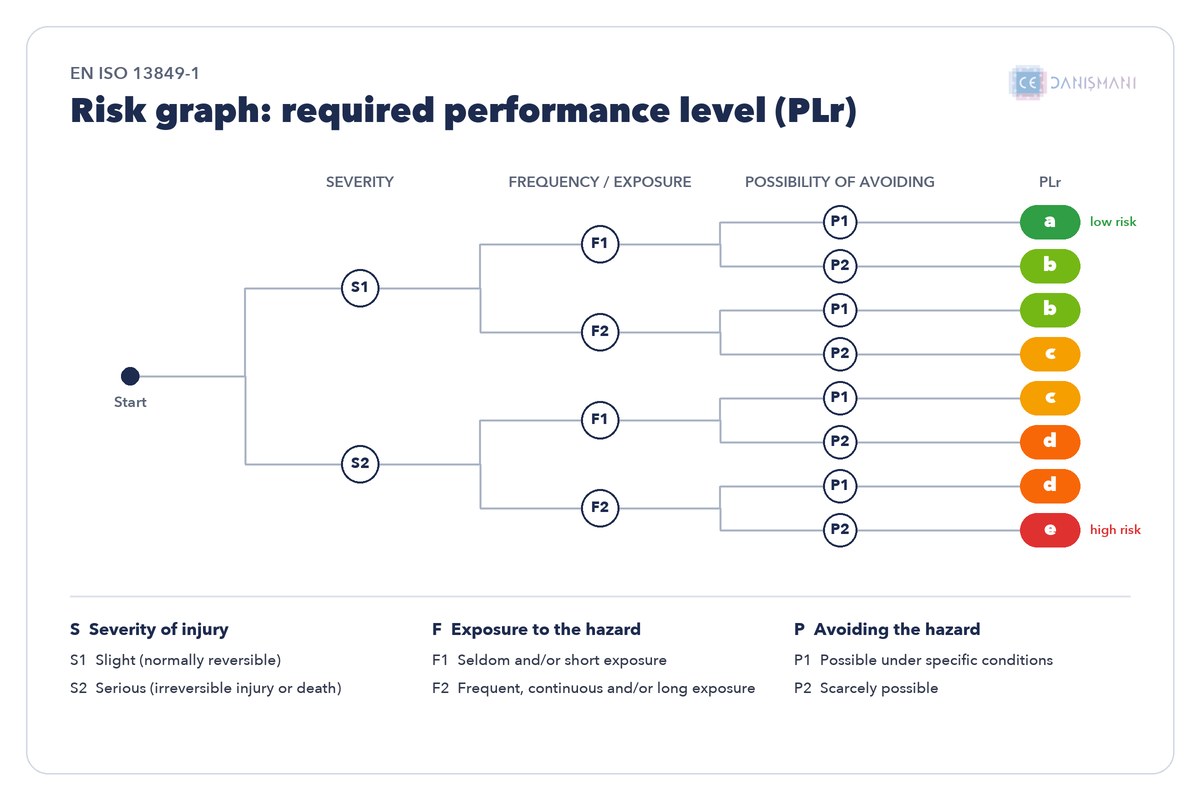
The graph is read from left to right:
- S, severity of injury: S1 slight, normally reversible injury; S2 serious, irreversible injury or death.
- F, frequency and duration of exposure: F1 seldom and/or short exposure; F2 frequent, continuous and/or long exposure.
- P, possibility of avoiding the hazard: P1 possible under specific conditions; P2 scarcely possible.
Example: on a press where the operator reaches into the die area in every cycle, the injury is irreversible (S2), exposure is continuous (F2) and escaping the closing die is scarcely possible (P2). The graph gives PLr “e” on this branch, and the protective system has to be designed to reach that level.
This graph applies only to measures that depend on the control system. For the overall risk estimation of all hazards of the machine, risk graphs or risk matrices that work on the same logic are used; ISO/TR 14121-2 gives examples.
Risk reduction in three steps
The most important rule of the standard is the order of the measures. The next step is used only where the previous one cannot reduce the risk enough.
- Inherently safe design: The hazard is removed or reduced by design. Examples: a geometry that removes the trapping point, lower force and speed, no sharp edges.
- Safeguarding: For risks that design cannot remove, guards, interlocking devices, light curtains and complementary measures such as the emergency stop.
- Information for use: For the residual risks, warning signs, audible and visual signals and the instruction handbook.
A warning label or personal protective equipment is not accepted as the solution for a risk that could be removed by design or by a guard. This is the gap most often found in inspections.
Example: how one hazard line is written
The line below is an example prepared to show the method; the rating scale depends on the method the manufacturer has chosen.
| Machine and phase | Belt conveyor, cleaning |
|---|---|
| Hazard | Hand drawn in between the rotating drum and the belt |
| Initial risk | High severity (loss of limb), frequent exposure, low possibility of avoidance: not acceptable |
| Step 1 measure | Gap between drum and frame closed by design |
| Step 2 measure | Fixed guard at the drawing-in point; interlocking device on the cleaning cover |
| Step 3 measure | Warning sign; instruction to isolate the energy supply before cleaning |
| Residual risk | Low: acceptable |
| Standards applied | EN ISO 14120, EN ISO 14119, EN ISO 13857 |
What the risk assessment report contains
- Description of the machine, its intended use and its limits
- Data and assumptions used: loads, strengths, safety factors
- The hazards, hazardous situations and hazardous events considered
- The risk estimation for each hazard and the method used
- The protective measures taken and the standards applied
- The residual risks and the information given to the user
- The result of the assessment, its date and the persons who prepared it
The report lives with the machine. It is updated when the design is changed or a new hazard is noticed.
High-risk machinery
Some types, such as presses, plastics injection moulding machines and hand-fed woodworking machines, are on the list of high-risk machinery of the Directive (2006/42/EC Annex IV). The risk assessment is done with the same method for these machines; the conformity assessment route is determined separately.
What changes with the new Machinery Regulation?
Regulation (EU) 2023/1230, which applies from 20 January 2027, keeps the risk assessment obligation. Topics such as software, cybersecurity and self-learning systems also come within the assessment. For machines placed on the market after that date the risk assessment has to be reviewed against the new requirements.
Frequently asked questions
Who carries out the risk assessment?
The manufacturer is responsible. The work is done together with the design team that knows the machine.
Is there an “ISO 12100 certificate”?
EN ISO 12100 is a method standard. Its output is the risk assessment report in the technical file; the CE marking and the EU Declaration of Conformity of the machine rest on that report.
Does a used or old machine need a risk assessment?
If the machine has been substantially modified, or is imported from outside the EU for the first time, the risk assessment and the CE marking process are carried out again.
How is it done for machines working as a line?
Machines that work together are treated as a whole. The assessment of each machine is not enough; the transfer points between machines and the common control system are assessed as well.
Which edition applies?
The edition cited in the EU Official Journal is EN ISO 12100:2010. The current citation should be checked before the work starts.
Can a manufacturer in Turkey use the same assessment for the EU?
Yes. Turkey applies the same machinery legislation and the same standard, so one risk assessment and one technical file serve both markets. See machinery CE marking for the overall process.


