
EN ISO 14119, “Safety of machinery – Interlocking devices associated with guards – Principles for design and selection (ISO 14119:2013)”, defines how the safety switches fitted to movable guards are selected and installed. The aim is that the hazardous movement cannot run while the guard is open and stops when the guard is opened. The standard also deals with measures that make these devices hard to defeat.
Let us take care of EN ISO 14119 testing and the CE marking of your machine together; CE Danışmanı (CE Consultant) manages the whole process.
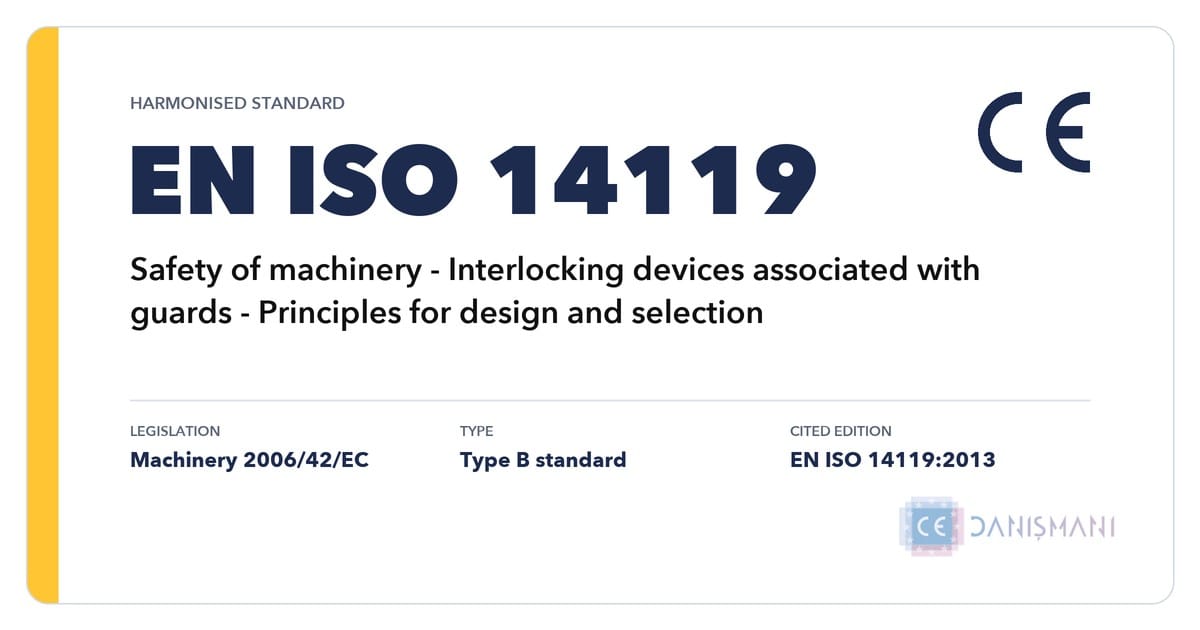
EN ISO 14119 at a glance
| Edition cited in the EU Official Journal | EN ISO 14119:2013 |
|---|---|
| Official title | Safety of machinery – Interlocking devices associated with guards – Principles for design and selection (ISO 14119:2013) |
| Legislation supported | Machinery Directive 2006/42/EC; from 20 January 2027 Machinery Regulation (EU) 2023/1230 |
| Type of standard | Type B standard |
Which devices are covered?
The standard divides interlocking devices into four types by actuation principle and coding:
- Type 1: mechanically actuated, uncoded (hinge switch, cam-operated position switch)
- Type 2: mechanically actuated, coded (tongue-operated safety switch, trapped-key systems)
- Type 3: non-contact, uncoded (inductive, magnetic, capacitive, optical proximity sensors)
- Type 4: non-contact, coded (RFID or coded magnetic safety sensors)
Devices with guard locking, which keep the guard locked until the hazard has passed, are also covered. The standard deals with the device, not with the guard itself; guard construction belongs to EN ISO 14120. The safety level of the control circuit is set by EN ISO 13849-1 or EN IEC 62061.
Main requirements of the standard
- Interlocking function: The hazardous machine function cannot operate until the guard is closed; opening the guard gives a stop command.
- Need for guard locking: If the machine takes longer to stop than a person needs to reach the hazard zone, the guard is kept locked until the hazard has ended.
- Locking principle: Devices that lock by spring force and unlock by power stay locked when power is lost and are preferred for personal protection.
- Release functions: Escape release from inside, emergency release from outside and auxiliary release are defined for guard locking devices.
- Minimising defeat: Defeat by simple means such as tape, a spare actuator or a magnet is made difficult by concealed mounting, coded actuators and non-detachable fixings.
- Direct opening action: In mechanical switches the contacts are forced open by the movement of the guard.
EN ISO 14119 verification and checks
Interlocking devices are verified on the machine by inspection and functional tests. Evidence of the safety level is part of the validation to EN ISO 13849-2.
| Test or check | What is verified? |
|---|---|
| Functional test | The machine cannot be started with the guard open, and the hazardous movement stops when the guard is opened |
| Guard locking test | The guard cannot be opened during hazardous movement and unlocks only after the hazard has ended |
| Escape and emergency release | A person inside can get out and the machine stops when they do |
| Mounting inspection | Switch and actuator are firmly fixed and correctly aligned |
| Assessment of defeat | Whether operators have a reason to defeat the device, and whether the measures taken are adequate |
Where several door switches are wired in series, a fault can remain hidden; this is taken into account in the performance level calculation.
Its place in the CE marking process
- Risk assessment: The places that need a movable guard, the frequency of access and the stopping time of the machine are identified under EN ISO 12100.
- Design: Device type, need for guard locking and coding level are chosen to EN ISO 14119.
- Verification: Functional tests are carried out and the possibility of defeat is assessed.
- Technical file: Device data sheets, circuit diagrams and test records go into the technical file.
- Declaration of conformity: EN ISO 14119 is listed among the standards applied.
Conformity with a harmonised standard gives presumption of conformity with the relevant essential requirements of the machinery legislation. Turkey applies the same rules through its own regulation aligned with 2006/42/EC. See also CE marking of machinery.
Standards applied together
- EN ISO 14120: Design of fixed and movable guards
- EN ISO 13849-1: Performance level of the interlocking function
- EN ISO 13855: Minimum distance for guards without guard locking
- EN ISO 14118: Prevention of unexpected start-up
Frequently asked questions
When does a guard need a locking switch?
Guard locking is needed when the machine stops later than a person can reach the hazard after opening the guard. If the stopping time is short, a switch without locking and enough distance may be sufficient.
What if operators bypass the switch?
Find the reason first. Devices are often defeated because there is no suitable operating mode for setting or cleaning. The standard asks for that reason to be removed and for defeat to be made difficult.
Which edition applies?
The edition cited in the EU Official Journal is EN ISO 14119:2013. Check the current citation before testing starts.
Other standards in this group
- EN ISO 13855: Positioning of Safeguards
- EN ISO 13857: Safety Distances
- EN ISO 14120: Fixed and Movable Guards
- EN ISO 14118: Prevention of Unexpected Start-Up

