

Machinery Risk Assessment to EN ISO 12100
October 1, 2026
FDA Registration for Exporters to the United States
October 1, 2026

EN ISO 13849-1 is the standard for the safety-related parts of machine control systems. When a risk on a machine is reduced by a control function, for example an interlocked guard, a light curtain or an emergency stop, this standard is used to decide how reliable that function must be and to show that the design achieves it. The current edition is EN ISO 13849-1:2023. Part 2, EN ISO 13849-2, covers validation.
For EN ISO 13849-1 calculations and validation, apply to CE Danışmanı (CE Consultant); we manage the whole process for you.
Where it fits
The Machinery Directive 2006/42/EC, and the equivalent regulation in Turkey, require machines to meet essential health and safety requirements. Applying harmonised standards gives a presumption of conformity with the requirements they cover. The manufacturer has to:
- Design the machine so that it meets the essential health and safety requirements
- Provide instructions in the language of the country where the machine is placed on the market
- Draw up the technical documentation
- Issue the EU Declaration of Conformity and affix the CE marking correctly
The starting point is the risk assessment to EN ISO 12100. EN ISO 13849-1 is applied to each protective measure that depends on the control system.

Designing a safety function
- Build a safety concept from the machine, the people who use it, the environment and the guards.
- Define the safety functions. Each one consists of an input (sensor), logic and output (actuator) subsystem.
- Determine the required performance level for each safety function.
- Assess each subsystem for structure, reliability, fault detection, fault tolerance and process conditions.
- Define the protective devices: position, safety distance, size and height.
- Integrate the protective devices into the control system and select a suitable logic unit.
- Have the design and the documentation checked.
Performance level (PL)
The performance level describes the ability of the safety-related parts to perform a safety function under foreseeable conditions. There are five levels, from PL a (lowest) to PL e (highest).
The required performance level (PLr) comes from the risk and is determined from three criteria:
- Severity of the injury
- Frequency and duration of exposure to the hazard
- Possibility of avoiding the hazard
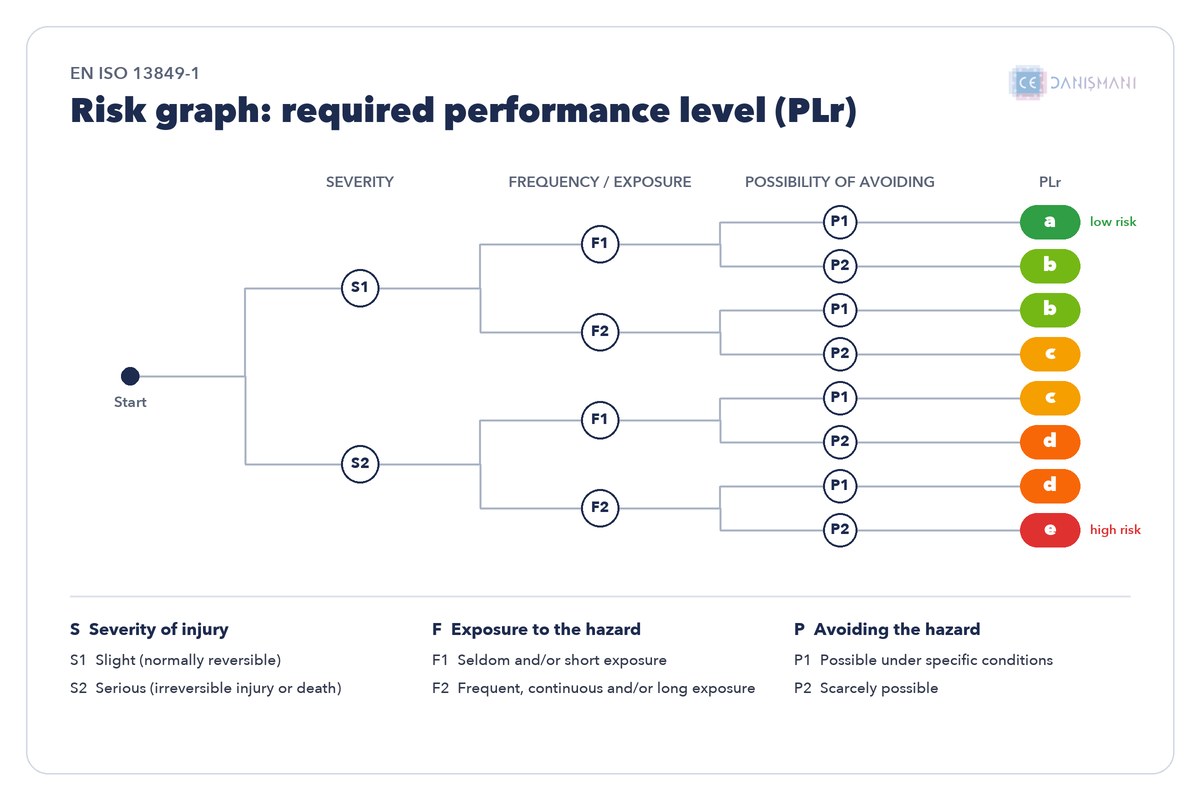
The risk graph is read from left to right: severity of injury (S1 slight, S2 serious), frequency and duration of exposure (F1 seldom and/or short, F2 frequent and/or long) and possibility of avoiding the hazard (P1 possible under specific conditions, P2 scarcely possible). The branch reached gives the PLr. Example: on a press where the operator reaches into the die area in every cycle, the result is S2, F2, P2 and therefore PLr “e”.
The designer then shows that the performance level actually achieved is at least equal to PLr. This can be done with a simplified method that combines the performance levels of the subsystems from a table, or with a detailed calculation.

Categories
The category describes the structure of the safety-related part and how it behaves when a fault occurs.
| Category | Behaviour |
|---|---|
| B | Basic safety principles are applied. A fault can lead to the loss of the safety function. |
| 1 | As B, with well-tried components and well-tried safety principles. A fault can still lead to the loss of the safety function, but it is less likely. |
| 2 | The safety function is checked at intervals by a test. Between two tests a fault can lead to the loss of the safety function; the test rate matters. |
| 3 | A single fault does not lead to the loss of the safety function. Some faults are detected, but an accumulation of undetected faults can lead to its loss. |
| 4 | A single fault does not lead to the loss of the safety function, and faults are detected in time, so that an accumulation of faults does not lead to its loss either. |
Diagnostic coverage (DC)
Diagnostic coverage is the ratio of the dangerous failures that are detected to all dangerous failures that can occur, expressed as a percentage. It is determined for the whole safety-related system or for a part of it, and it is one of the main inputs when a safety function is analysed.

Mission time
The standard assumes a mission time of 20 years for the safety-related parts. To reach it, the machine has to be maintained properly, and components have to be replaced before the end of their specified life.
Validation to EN ISO 13849-2
Validation confirms, by analysis and testing, that every safety-related part meets the specified requirements: the safety functions, the category and the performance level. It should be carried out by people who were not involved in the design of that part, and it should start as early as possible in the design, so that problems are found while they can still be solved.
Risk reduction in order
- Design the machine so that foreseeable risks are removed as far as possible.
- Define, design and check the protective measures for the risks that remain.
- Inform users about the residual risks.
- Define the safety functions and their required performance levels, and complete the safety concept.
- Confirm that the measures have been applied effectively.
How CE Danışmanı helps
- Identifying the safety functions of your machine and their required performance levels
- Calculating the achieved performance level and documenting it
- Preparing the validation plan and record to EN ISO 13849-2
- Preparing the technical file for machinery CE marking


