

What Is Accreditation?
October 1, 2026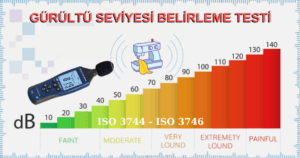
Noise Emission Testing to EN ISO 3744
October 1, 2026

IP testing determines how well the enclosure of an electrical product protects against access to hazardous parts, against solid foreign objects such as dust, and against water. “IP” stands for Ingress Protection. The result is expressed as an IP code, for example IP54, IP65 or IP67, and the method is defined in the standard EN 60529 (IEC 60529).
For IP testing, apply to CE Danışmanı (CE Consultant); we manage the whole process for you.
How to read an IP code
The code has two digits. The first shows protection against solid objects, the second protection against water. If one of the two is not declared, it is replaced by the letter X, as in IPX7.
| First digit | Protection against solid objects |
|---|---|
| 0 | No protection |
| 1 | Objects of 50 mm diameter and larger |
| 2 | Objects of 12.5 mm diameter and larger |
| 3 | Objects of 2.5 mm diameter and larger |
| 4 | Objects of 1 mm diameter and larger |
| 5 | Dust-protected: dust may enter, but not in a harmful quantity |
| 6 | Dust-tight |
| Second digit | Protection against water |
|---|---|
| 0 | No protection |
| 1 | Vertically falling drops |
| 2 | Vertically falling drops with the enclosure tilted up to 15 degrees |
| 3 | Spraying water, up to 60 degrees from the vertical |
| 4 | Splashing water from any direction |
| 5 | Water jets |
| 6 | Powerful water jets |
| 7 | Temporary immersion: 1 metre depth for 30 minutes |
| 8 | Continuous immersion under conditions specified by the manufacturer |
Example: an IP67 product is dust-tight (6) and withstands immersion at 1 metre for 30 minutes (7).

Which products are IP tested?
An IP rating is relevant for any product that will be used outdoors or in a dusty or wet environment. Typical examples:
- Outdoor luminaires, for example IP65 floodlights
- Industrial machinery, control cabinets and equipment used in factories, often IP65 or higher
- Electric vehicle charging stations
- Smartphones, tablets, smart watches and other wearables, often IPX7 or IPX8
- Garden tools, outdoor cameras and water-resistant loudspeakers
- Automotive parts exposed to the weather, such as headlamps and rear lamps
- Electronic equipment for boats and yachts
Who carries out the test?
IP tests are normally carried out by accredited test laboratories that work to EN 60529. Large manufacturers may also have their own laboratories for development testing. In Turkey, the standard is published by TSE (the Turkish Standards Institution) and laboratories are accredited by TÜRKAK (the Turkish Accreditation Agency).
How the process works
- Define the target. Decide which IP rating the product needs and which product standard applies.
- Review the product. The enclosure, seals, cable entries and materials are examined before testing, so that weak points can be corrected early.
- Select the laboratory and plan the test. The order of the tests, the test conditions and the number of samples are agreed.
- Testing. The dust and water tests are carried out and followed up with the laboratory.
- Test report. The report states the IP rating achieved and is added to the technical file of the product.
If the product fails, the cause is identified and design changes are proposed, for example a different sealing method or material, before the test is repeated.
IP testing and CE marking
An IP test checks protection against the physical environment. It is often carried out together with LVD safety tests, where the product standard requires a declared IP rating, and with EMC testing, which covers the electromagnetic environment. The test reports become part of the technical file behind the CE marking.
How CE Danışmanı helps
- Identifying the IP rating and the standards that apply to your product
- Reviewing the product before testing and advising on design changes
- Selecting an accredited laboratory and coordinating the tests
- Following up the results and resolving failures
- Combining IP tests with LVD and EMC tests where the product needs them


