
Ecodesign: Directive 2009/125/EC and the ESPR, Regulation (EU) 2024/1781
October 1, 2026
Gas Appliances Regulation (EU) 2016/426 (GAR)
October 1, 2026
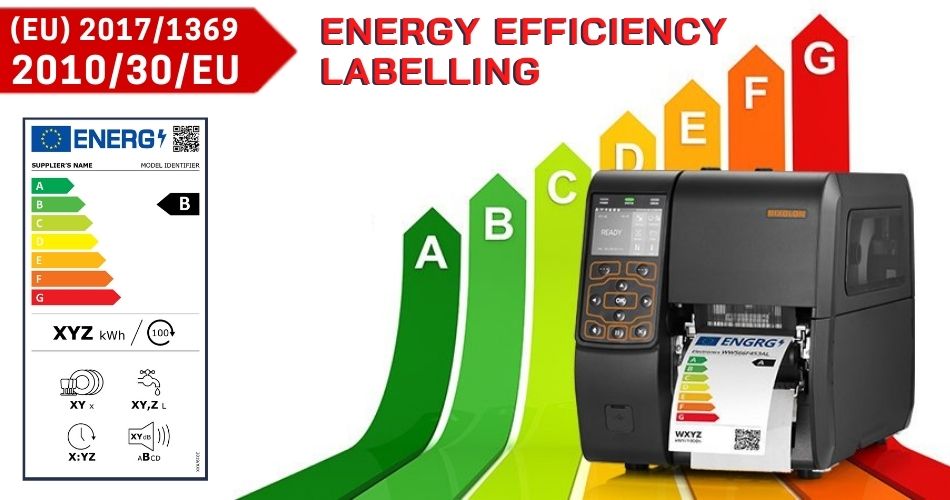
Regulation (EU) 2017/1369 sets the framework for energy labelling in the EU. It requires energy-related products to be supplied with a label and standard product information on their energy efficiency and their consumption of energy and other resources during use, so that customers can choose more efficient products. It replaced Directive 2010/30/EU.
For energy labelling and CE marking of your product, apply to CE Danışmanı (CE Consultant); we manage the whole process for you.
How the framework works
The Regulation itself does not contain the label for any product. It sets the general duties of suppliers and dealers, the rules on the product database and on market surveillance. The label design, the efficiency classes and the measurement methods for each product group are laid down in separate delegated acts.

The label: A to G
The label ranks products on a scale from A (most efficient, dark green) to G (least efficient, red). Earlier labels had added the classes A+, A++ and A+++ on top of A. The Regulation removes them: product groups are being rescaled back to a plain A to G scale, with the top classes left almost empty at first to leave room for future improvement. Rescaled labels already apply to household refrigerating appliances, dishwashers, washing machines and washer-dryers, electronic displays including televisions, and light sources.
Besides the class, the label shows the energy consumption in kWh, for a year or per number of cycles depending on the product, and other parameters such as capacity, water consumption or noise. A QR code on rescaled labels links to the product’s public entry in the database.
Product groups with an energy label
- Household refrigerating appliances
- Professional refrigerated storage cabinets
- Electronic displays and televisions
- Air conditioners
- Household washing machines and washer-dryers
- Household dishwashers
- Household tumble dryers
- Domestic ovens and range hoods
- Light sources
- Water heaters, hot water storage tanks and packages with solar devices
EPREL: the product database
Before placing a model on the EU market, the supplier registers it in the European Product Registry for Energy Labelling (EPREL). The entry contains:
- Name or trade mark, address and contact details of the supplier
- The model identifier
- The label in electronic format
- The energy efficiency class and the other parameters on the label
- The parameters of the product information sheet
The public part of the database lets anyone look up a model, view and download its label and its information sheet. A second part, with the technical documentation, is accessible to market surveillance authorities.
Supplier’s duties
The supplier is the manufacturer established in the EU, the authorised representative or the importer.
- Supply each unit with an accurate printed label and the product information sheet, at no charge to the dealer
- Make sure the label and the information sheet are accurate and draw up technical documentation that allows this to be verified
- Register the model in the product database before placing it on the market
- Refer to the energy efficiency class, and the range of classes available, in advertisements and technical promotional material for the model
- Not use other labels, marks or symbols that could mislead or confuse customers about energy consumption
Dealer’s duties
- Display the label supplied for the model visibly, including in online sales
- Make the product information sheet available to customers
- Refer to the energy efficiency class and the range of classes in advertisements and promotional material
Energy labelling and CE marking
The energy label is not the CE marking and does not replace it. The same product is usually subject to an ecodesign measure, which sets the minimum efficiency it must reach and is part of the CE marking, and to a labelling act, which tells the customer where the product stands above that minimum. The two are measured with the same test methods. See ecodesign and CE marking.
Energy labelling in Turkey
Turkey has its own framework regulation on energy labelling, aligned with EU legislation, and product-specific communiqués for the groups listed above. For the Turkish market the label and the product information sheet are provided in Turkish. Non-compliant suppliers and dealers face penalties under the Turkish consumer protection law (No 6502) and the law on technical legislation for products (No 4703, since replaced by the Product Safety and Technical Regulations Law No 7223).
How CE Danışmanı helps
- Determining which labelling act and which ecodesign measure apply to your product
- Coordinating the energy-efficiency measurements with accredited laboratories
- Preparing the label, the product information sheet and the technical documentation
- Supporting the database registration


