
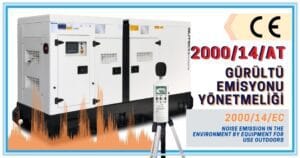
Outdoor Noise Directive 2000/14/EC
October 1, 2026
Simple Pressure Vessels Directive 2014/29/EU (SPVD)
October 1, 2026

The Lifts Directive 2014/33/EU sets the essential health and safety requirements that lifts and safety components for lifts must meet before they are placed on the market or put into service. It applies to lifts permanently serving buildings and constructions and intended for the transport of persons, persons and goods, or goods alone where the carrier is accessible.
For CE marking of lifts and lift safety components, apply to CE Danışmanı (CE Consultant); we manage the whole process for you.
What is a lift under the Directive?
A lift is a lifting appliance serving specific levels, with a carrier that moves along guides which are rigid and inclined at an angle of more than 15 degrees to the horizontal. Lifting appliances that move along a fixed course even though they do not move along rigid guides are also in scope. A goods-only lift is covered where a person can enter the carrier without difficulty and the controls are inside the carrier or within reach of a person inside.
Safety components covered
- Devices for locking landing doors
- Devices to prevent the car from falling or from uncontrolled movement
- Overspeed limitation devices
- Energy-accumulating buffers, non-linear or with damping of the return movement
- Energy-dissipating buffers
- Safety devices fitted to the jacks of hydraulic power circuits, where these are used to prevent falls
- Electric safety devices in the form of safety circuits containing electronic components
What is excluded
- Lifting appliances whose speed is not greater than 0.15 m/s
- Construction site hoists
- Cableways, including funicular railways
- Lifts specially designed and constructed for military or police purposes
- Lifting appliances from which work can be carried out
- Mine winding gear
- Lifting appliances intended for lifting performers during artistic performances
- Lifting appliances fitted in means of transport
- Lifting appliances connected to machinery and intended exclusively for access to workstations
- Rack and pinion trains
- Escalators and mechanical walkways
Many of these fall under machinery legislation instead. See machinery CE marking.
Who does what
| Operator | Main duties |
|---|---|
| Installer | Is responsible for the design, manufacture, installation and placing on the market of the lift. Carries out the conformity assessment, draws up the EU Declaration of Conformity and affixes the CE marking in each car. Keeps the technical documentation and the declaration for 10 years after the lift is placed on the market. |
| Manufacturer of safety components | Designs and manufactures the component to the essential requirements, carries out the conformity assessment, draws up the declaration and affixes the CE marking. Keeps the documents for 10 years. |
| Authorised representative | Acts under a written mandate; keeps the declaration and the technical documentation available for the authorities. |
| Importer | Places only compliant safety components on the market; checks that the manufacturer has carried out the conformity assessment and that the component carries the CE marking and the required documents; indicates its own name and address. |
| Distributor | Verifies the CE marking, the declaration and the instructions before making a safety component available. |
Conformity assessment
A notified body takes part in every route.
Lifts
- EU-type examination of a model lift, followed by final inspection, or by product or production quality assurance
- Design under an approved full quality assurance system, followed by final inspection, or by product or production quality assurance
- Unit verification
- Full quality assurance plus design examination
Safety components
- EU-type examination, followed by conformity to type with random checking
- EU-type examination, followed by product quality assurance
- Full quality assurance
CE marking
The CE marking is affixed visibly, legibly and indelibly to each lift car and to each safety component. Where that is not possible for a safety component, it goes on a label inseparably attached to it. The marking is affixed before the lift or the component is placed on the market and is followed by the identification number of the notified body involved in the final inspection, unit verification or quality assurance procedure.
Typical non-conformities
- The CE marking is missing or has been affixed incorrectly
- The identification number of the notified body is missing
- The EU Declaration of Conformity has not been drawn up, or not correctly
- The technical documentation is unavailable or incomplete
- The name, trade mark or address of the installer, manufacturer or importer is not indicated
- The information that identifies the lift or the component is missing
- The instructions are missing or not adequate
If the non-conformity continues, the authority can restrict or prohibit the use of the lift or the making available of the component.
Lifts in Turkey
Turkey applies the Directive through its own Lifts Regulation, published in the Official Gazette in 2016 and aligned with 2014/33/EU. Imported safety components are checked through TAREKS.


