
EN ISO 13857, “Safety of machinery – Safety distances to prevent hazard zones being reached by upper and lower limbs (ISO 13857:2019)”, uses tables to define how far a protective structure must be from a hazard. Design decisions such as the height of a fence, the mesh size of a guard or the width of a feed opening are taken from this standard. The values are based on human body dimensions.
Let us take care of EN ISO 13857 testing and the CE marking of your machine together; CE Danışmanı (CE Consultant) manages the whole process.
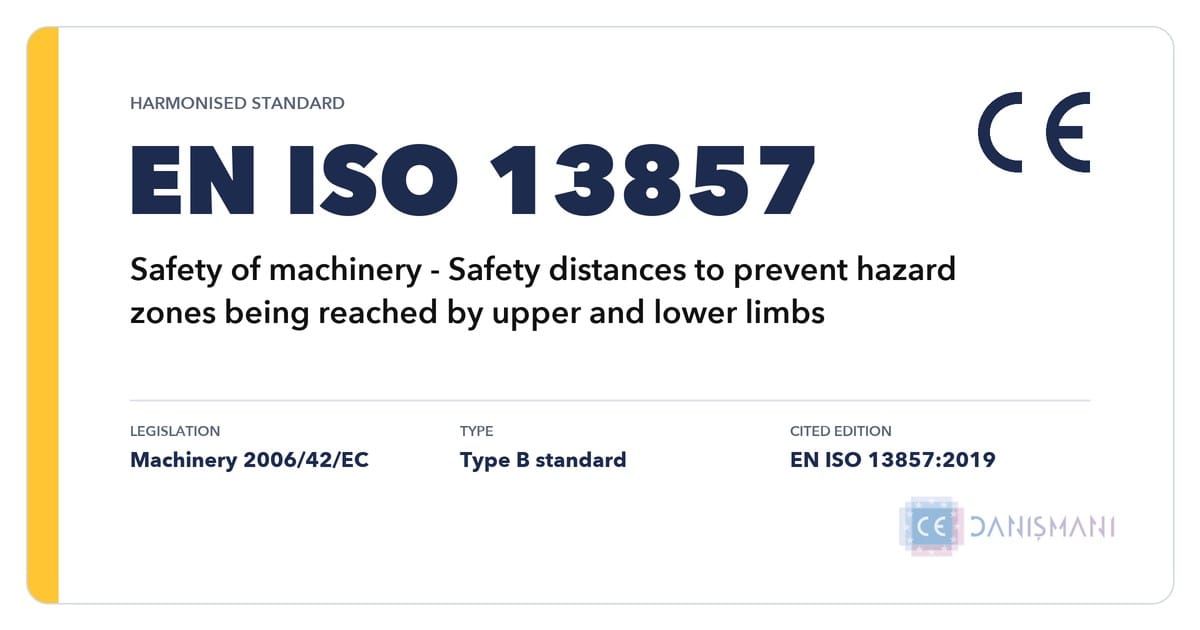
EN ISO 13857 at a glance
| Edition cited in the EU Official Journal | EN ISO 13857:2019 |
|---|---|
| Official title | Safety of machinery – Safety distances to prevent hazard zones being reached by upper and lower limbs (ISO 13857:2019) |
| Legislation supported | Machinery Directive 2006/42/EC; from 20 January 2027 Machinery Regulation (EU) 2023/1230 |
| Type of standard | Type B standard |
| Reaching upwards | The hazard zone must be at least 2,500 mm above the floor for low risk and 2,700 mm for high risk; otherwise other protective measures are needed |
Which situations are covered?
The standard applies where protection is achieved by distance alone, for machines in industrial and non-industrial environments. Typical applications:
- Perimeter fences of robot cells and automation lines
- Mesh, perforated sheet and grid guards
- Feed and discharge openings, hoppers
- Openings under and beside conveyors
- Belt, pulley and chain drive enclosures
The tables are written for persons of 14 years and above; for reaching through openings there are separate values for children of 3 years and above. The standard gives no distances against deliberate attempts such as climbing over, or against hazards such as radiation and emissions. Minimum gaps against crushing are in EN ISO 13854 and light curtain distances in EN ISO 13855.
Main requirements of the standard
- Reaching upwards: No guard is needed if the hazard zone is high enough; the height limit depends on the risk level.
- Reaching over protective structures: Fence height, height of the hazard zone and horizontal distance depend on each other; a suitable combination is taken from the table.
- Low and high risk: There are two tables for reaching over; the risk assessment decides which one is used.
- Reaching round: Distances are given for an arm that bends at the elbow, wrist or finger joints.
- Reaching through openings: Depending on the shape (slot, square, round) and size of the opening, the tables show how far a finger, hand or arm can pass.
- Lower limbs: Separate distances cover feet and legs reaching through openings.
Values between two table rows are not interpolated; the safer value is used.
EN ISO 13857 verification and checks
Verification is not a laboratory test; it is done by measurement on the machine and review of the design drawings.
| Test or check | What is verified? |
|---|---|
| Guard height | The height of the fence or guard meets the value chosen from the table |
| Horizontal distance | The distance between the guard and the nearest hazard point is sufficient |
| Opening size | The largest dimension of mesh, slots or holes matches the distance |
| Gap between floor and guard | Lower limb distances are met against reaching underneath |
| Reference plane | Steps, platforms and other surfaces a person can stand on are taken into account |
Measurements are recorded together with the drawings. If a step, pallet or platform is later placed next to the guard, the reference plane changes and the check is repeated.
Its place in the CE marking process
- Risk assessment: The hazard points that can be reached and the risk level are identified under EN ISO 12100.
- Design: Guard height, position and opening sizes are taken from the EN ISO 13857 tables.
- Verification: Distances and openings are measured on the machine.
- Technical file: Guard drawings and measurement records go into the technical file.
- Declaration of conformity: EN ISO 13857 is listed among the standards applied.
Conformity with a harmonised standard gives presumption of conformity with the relevant essential requirements of the machinery legislation. Turkey applies the same rules through its own regulation aligned with 2006/42/EC. See also CE marking of machinery.
Standards applied together
- EN ISO 14120: Design of fixed and movable guards
- EN ISO 13855: Positioning of safeguards with respect to approach speeds
- EN ISO 13854: Minimum gaps to avoid crushing of parts of the body
- EN ISO 14119: Interlocking devices associated with guards
Frequently asked questions
How high should a perimeter fence be?
There is no single value. The height is taken from the table according to the height of the hazard point, the distance of the fence from it and the risk level. The closer the fence, the higher it has to be.
Do these distances apply to light curtains?
No. For detecting devices such as light curtains, the distance is calculated from the stopping time of the machine using EN ISO 13855.
Which edition applies?
The edition cited in the EU Official Journal is EN ISO 13857:2019. Check the current citation before testing starts.
Other standards in this group
- EN ISO 13850: Emergency Stop Function
- EN ISO 13855: Positioning of Safeguards
- EN ISO 14119: Interlocking Devices for Guards
- EN ISO 14120: Fixed and Movable Guards

