
EN ISO 23125, “Machine tools – Safety – Turning machines (ISO 23125:2015, Corrected version 2016-03-15)”, is the type C standard for machines on which the workpiece rotates and the cutting tool is stationary. The most serious hazards are entanglement with the rotating chuck and workpiece, and ejection of a workpiece or a chuck jaw. The standard deals with them according to the group of machine and the mode of operation.
Let us take care of EN ISO 23125 testing and the CE marking of your machine together; CE Danışmanı (CE Consultant) manages the whole process.
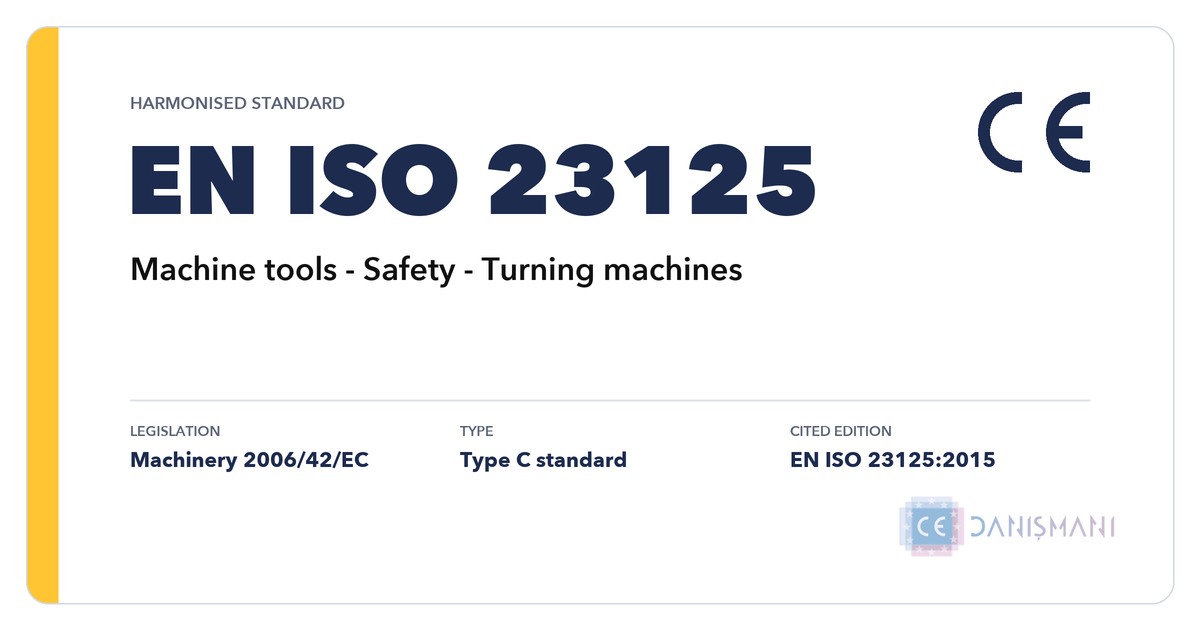
EN ISO 23125 at a glance
| Edition cited in the EU Official Journal | EN ISO 23125:2015 |
|---|---|
| Official title | Machine tools – Safety – Turning machines (ISO 23125:2015, Corrected version 2016-03-15) |
| Legislation supported | Machinery Directive 2006/42/EC; from 20 January 2027 Machinery Regulation (EU) 2023/1230 |
| Type of standard | Type C standard |
Which machines does it cover?
The standard divides turning machines into four groups and states which requirements apply to each:
- Manually controlled turning machines without numerical control
- Manually controlled turning machines with limited numerical control capability
- Numerically controlled turning machines and turning centres
- Single-spindle and multi-spindle automatic turning machines
Machines are also divided into small and large; on large machines the operator has to enter the work zone, so the requirements differ. Bar feeders, swarf conveyors and workpiece loading devices are included. Machining centres are dealt with in EN 12417.
Main requirements of the standard
- Work zone guards: On numerically controlled machines the work zone is enclosed by guards strong enough to contain ejected parts and swarf.
- Interlocking and guard locking: Movable guards are interlocked; in automatic mode the guard stays locked until the spindle has stopped.
- Modes of operation: Manual, automatic and setting modes are defined separately and selected with a lockable device.
- Limits in setting mode: With the guard open, movements are allowed only at reduced speed and with an enabling device or hold-to-run control.
- Workholding: The maximum permitted speed of the chuck must not be exceeded; with power clamping, loss of clamping force is monitored.
- Spindle speed limitation: The control system prevents the speed limit set for the workholding device being exceeded.
- Vision panels: Panels are made of impact-resistant material and protected against ageing caused by metalworking fluids.
- Other hazards: Measures for fluids and mist, fire, noise, electricity and ergonomics.
Verification and tests under EN ISO 23125
The standard names the verification method for each requirement. An annex describes an impact test for the strength of guards.
| Test or check | What is verified? |
|---|---|
| Visual inspection | Guards, control devices, marking and warnings are complete |
| Guard impact test | Guard and panel materials belong to a resistance class that contains ejected parts |
| Interlock functional test | The automatic cycle does not start with the guard open and the lock is not released before the spindle stops |
| Mode and speed tests | Speed limits and the enabling device work in setting mode |
| Workholding and control system review | Speed limit, clamping pressure monitoring and the required performance level of the safety functions |
Results are recorded in the test report. Noise is measured separately under the operating conditions defined for the machine.
Where it fits in CE marking
- Risk assessment: The machine group is determined and the hazards are assessed under EN ISO 12100.
- Design: Guards, interlocks, modes and workholding are designed to EN ISO 23125.
- Verification: Functional tests and measurements are made on the machine; impact test evidence is collected for the guard material.
- Technical file: Risk assessment, diagrams and the test report go into the technical file.
- Declaration of conformity: EN ISO 23125 is listed among the standards applied.
Conformity with a harmonised standard gives presumption of conformity with the essential requirements it covers; see CE marking of machinery.
Standards applied together
- EN ISO 14120: design of fixed and movable guards
- EN ISO 14119: interlocking devices associated with guards
- EN 60204-1: electrical equipment of the machine
- EN ISO 13849-1: safety-related parts of control systems
- EN 1550: safety of work-holding chucks
Frequently asked questions
Must a manual lathe be fully enclosed?
No. Manually controlled machines have different requirements, such as a chuck guard and a chip shield.
Can setting be done with the guard open?
In setting mode, limited movements are allowed at reduced speed with an enabling device. The automatic cycle does not run with the guard open.
Which edition applies?
The edition cited in the EU Official Journal is EN ISO 23125:2015. The current citation should be checked before testing starts.
Other standards in this group
- EN 12622: Hydraulic Press Brakes
- EN ISO 16092-1: Presses General Safety Requirements
- EN ISO 10218-1: Industrial Robots
- EN ISO 10218-2: Robot Systems and Integration

