
EN ISO 10218-2, “Robots and robotic devices – Safety requirements for industrial robots – Part 2: Robot systems and integration (ISO 10218-2:2011)”, is the type C standard for turning an industrial robot into a working cell with an end-effector, safeguards and other machines. The integrator who builds the cell is the manufacturer of the resulting machine. The standard explains how that responsibility is met from design to commissioning.
Let us take care of EN ISO 10218-2 testing and the CE marking of your machine together; CE Danışmanı (CE Consultant) manages the whole process.
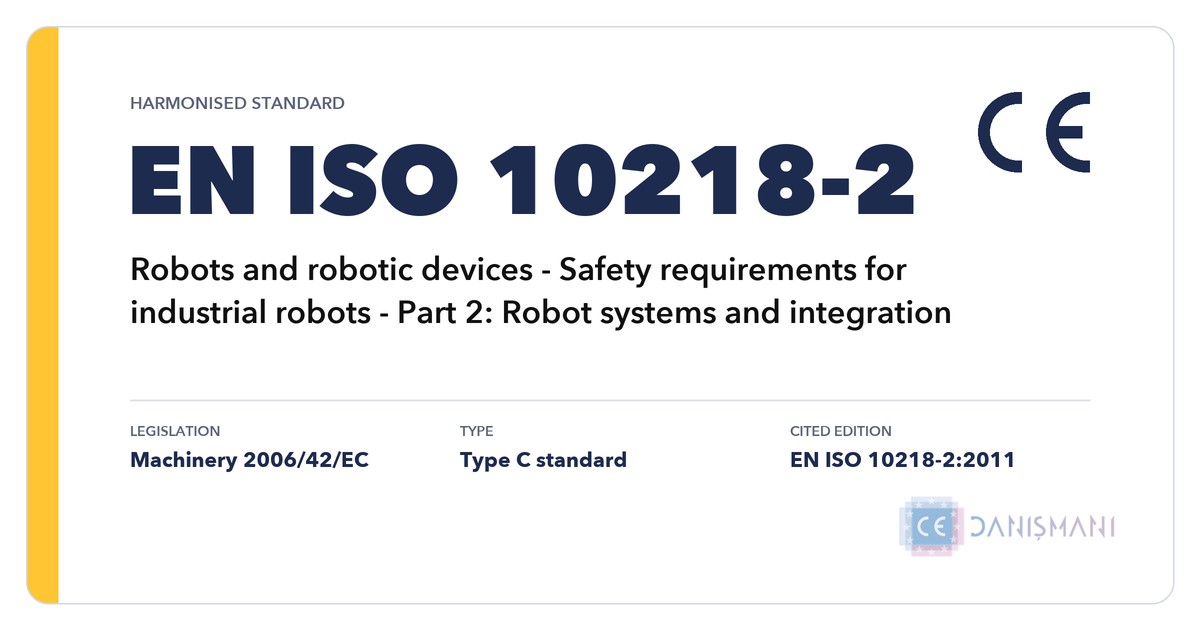
EN ISO 10218-2 at a glance
| Edition cited in the EU Official Journal | EN ISO 10218-2:2011 |
|---|---|
| Official title | Robots and robotic devices – Safety requirements for industrial robots – Part 2: Robot systems and integration (ISO 10218-2:2011) |
| Legislation supported | Machinery Directive 2006/42/EC; from 20 January 2027 Machinery Regulation (EU) 2023/1230 |
| Type of standard | Type C standard |
Which systems does it cover?
The standard covers industrial robot systems, robot cells and production lines with robots. Typical examples:
- Welding, grinding and deburring cells
- Palletising and case-packing cells
- Robots tending machine tools, presses and injection moulding machines
- Collaborative applications with a shared workspace
The requirements for the robot itself are in EN ISO 10218-1. Hazards of the process, such as welding radiation or lasers, are assessed with the relevant other standards.
Main requirements of the standard
- Layout design: The maximum, restricted and operating spaces of the robot are defined; the safeguarded space follows from them and trapping points are designed out.
- Perimeter safeguarding: The cell is enclosed by fixed guards and interlocked gates placed outside the restricted space.
- Protective devices: Light curtains, laser scanners and pressure-sensitive mats are placed at a distance calculated from the stopping time.
- Presence inside the cell and restart: Automatic operation cannot be started while a person is inside; the reset device is placed where the whole cell can be seen.
- End-effector: The part must not fall or be ejected when energy is lost.
- Manual load stations: Access to the robot is prevented where the operator hands in parts.
- Safety performance of the control system: Safety functions meet PL d with a category 3 structure, unless the risk assessment shows otherwise.
- Collaborative operation: The collaborative workspace is marked and the conditions of the chosen method are verified for the application.
Verification and tests under EN ISO 10218-2
An annex lists the accepted verification methods for each requirement. Verification is done on site after the cell is installed.
| Test or check | What is verified? |
|---|---|
| Inspection of layout and guards | Guard height, openings and reach distances match the design |
| Stopping time measurement and distance calculation | Light curtains and scanners are far enough away |
| Interlock functional test | The robot and other dangerous movements stop when a gate is opened |
| Reset and restart test | The cell cannot be started with a person inside |
| Space limiting and end-effector tests | The robot stays within the defined limits and the part is held on loss of energy |
Results are recorded in the commissioning report; checks are repeated when the layout or the program changes.
Where it fits in CE marking
- Risk assessment: Hazards of the whole cell are identified under EN ISO 12100.
- Design: Layout, safeguards and control architecture are designed to EN ISO 10218-2.
- Verification: Measurements and functional tests are made on the installed cell.
- Technical file: Layout plan, diagrams, calculations and the test report go into the technical file.
- Declaration of conformity: EN ISO 10218-2 is listed among the standards applied.
Conformity with a harmonised standard gives presumption of conformity with the essential requirements it covers; see CE marking of machinery.
Standards applied together
- EN ISO 10218-1: safety requirements for the robot itself
- EN ISO 13855: positioning of safeguards with respect to approach speed
- EN ISO 13857: safety distances
- EN ISO 14119 and EN ISO 14120: interlocking devices and guards
- EN ISO 11161 and ISO/TS 15066: integrated manufacturing systems and collaborative applications
Frequently asked questions
Who is responsible for CE marking of the cell?
The party that combines robot, end-effector and safeguards into a cell is the manufacturer. This can be an integrator or a factory that builds its own cell.
Can a laser scanner replace the fence?
It can, but its distance must be calculated from the stopping time, and hazards it cannot protect against, such as ejected parts, must be dealt with separately.
Which edition applies?
The edition cited in the EU Official Journal is EN ISO 10218-2:2011. A newer edition has been published by CEN; for presumption of conformity the edition cited in the Official Journal is the one that counts. The current citation should be checked before testing starts.
Other standards in this group
- EN ISO 23125: Turning Machines
- EN ISO 10218-1: Industrial Robots
- EN 415-10: Packaging Machines General Requirements
- EN 619: Unit Load Conveyors

