
EN 55015, “Limits and methods of measurement of radio disturbance characteristics of electrical lighting and similar equipment”, limits the radio-frequency disturbance emitted by luminaires, LED drivers and lamps. It is an emission standard; the immunity requirements for lighting equipment are in a separate standard, EN 61547. The emission side of EMC testing for lighting products is done to this standard.
Let us take care of EN 55015 testing and the CE marking of your product together; CE Danışmanı (CE Consultant) manages the whole process.
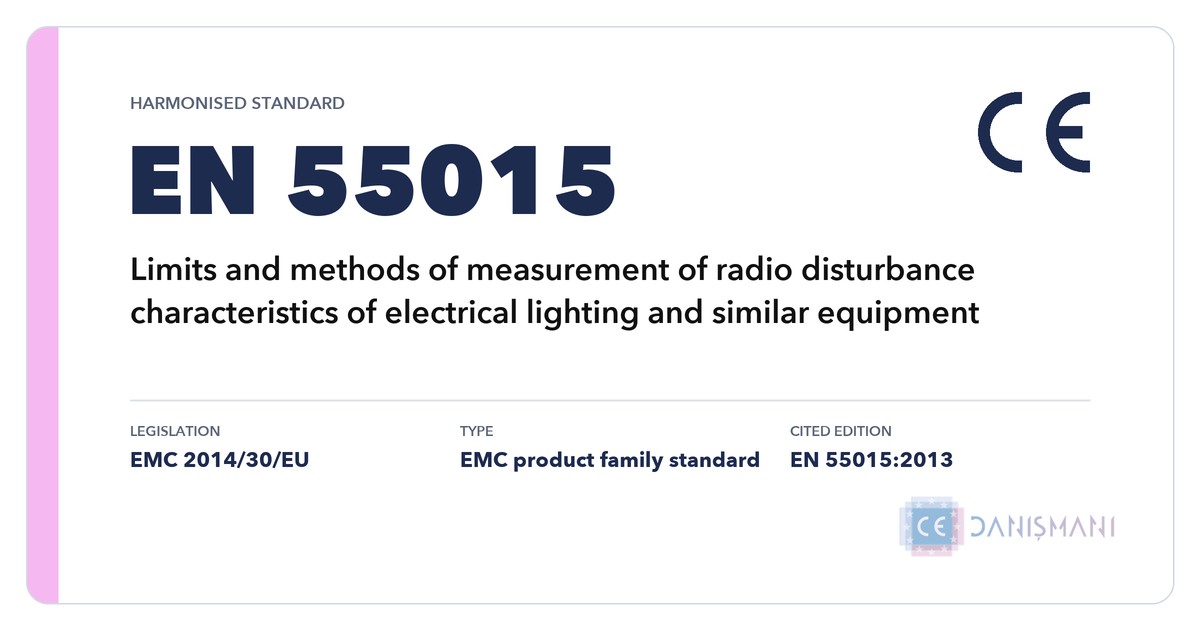
EN 55015 at a glance
| Edition cited in the EU Official Journal | EN 55015:2013 |
|---|---|
| Official title | Limits and methods of measurement of radio disturbance characteristics of electrical lighting and similar equipment |
| Legislation supported | EMC Directive 2014/30/EU |
| Type of standard | EMC product family standard |
Products covered
The standard applies to equipment whose main function is to generate or distribute light for illumination and which is connected to the low-voltage supply or runs on a battery. Typical examples:
- Indoor and outdoor luminaires, street lighting
- Independent auxiliaries such as LED drivers, electronic ballasts and transformers
- LED lamps and LED modules with integrated controlgear
- Dimmers and lighting control devices
- Illuminated advertising signs
High-frequency switching in electronic drivers is the main source of disturbance in these products. A lighting part inside another appliance is usually assessed with the emission standard of that appliance, for example EN 55014-1 for household appliances.
Main requirements of the standard
- Conducted disturbance at the mains port: Disturbance voltage is measured from 9 kHz to 30 MHz; this low starting frequency is particular to the lighting standard.
- Conducted disturbance at load and control ports: Disturbance is measured at the terminals between driver and light source and at control (dimming) terminals.
- Radiated magnetic field: The magnetic field radiated by the equipment is measured from 9 kHz to 30 MHz with a loop antenna.
- Radiated disturbance above 30 MHz: Radiated disturbance is measured from 30 MHz to 300 MHz; the standard also allows an alternative measurement method for this.
- Insertion loss: For luminaires with fluorescent lamps, the attenuation the luminaire gives to the disturbance produced by the lamp is measured.
- Application by product type: Which measurements apply is set separately for luminaires, independent auxiliaries and lamp types.
EN 55015 tests
The measurements are selected by product type and made with the product running in the arrangement defined by the standard.
| Test or check | What is verified? |
|---|---|
| Disturbance voltage at the mains port | Disturbance conducted into the mains is below the limits (artificial mains network) |
| Disturbance voltage at load and control ports | Disturbance conducted from the driver output and control lines is below the limits |
| Radiated magnetic field (loop antenna) | Low-frequency magnetic field radiation is below the limits |
| Radiated disturbance above 30 MHz | Disturbance radiated by the equipment and its cables is below the limits |
| Insertion loss measurement | The fluorescent luminaire gives the required attenuation |
| Harmonic current and flicker | Assessed with EN IEC 61000-3-2 (Class C for lighting equipment) and EN 61000-3-3 |
Its place in CE marking
- EMC assessment: The environment, the ports and the applicable emission and immunity standards are identified.
- Design: Driver selection, filtering, internal wiring and earthing of the body are designed with the emission limits in mind.
- Testing: Emission is tested to EN 55015 and immunity to EN 61547; harmonics and flicker tests are added.
- Technical file: The test report, set-up photographs and diagrams go into the technical file.
- Declaration of conformity: EN 55015 is listed among the standards applied and the CE marking is affixed.
Conformity with a harmonised standard gives presumption of conformity with the corresponding essential requirements of the EMC Directive 2014/30/EU. The safety side of lighting products is assessed under the LVD with EN IEC 60598-1.
Standards applied together
- EN 61547: EMC immunity requirements for general lighting equipment
- EN IEC 61000-3-2: Limits for harmonic current emissions
- EN 61000-3-3: Limits for voltage fluctuations and flicker
- EN IEC 60598-1: Safety of luminaires
- EN 61347-1: Safety of lamp controlgear
- EN IEC 62031: Safety of LED modules
Frequently asked questions
Is the driver’s EN 55015 report enough for the luminaire?
Not on its own. The disturbance level changes with cable length, the body and the LED module, so the luminaire must be measured in its own arrangement. Using a compliant driver still lowers the risk.
Does a lighting product need immunity testing?
Yes. EN 55015 covers emission only; immunity tests to EN 61547 are also carried out for EMC conformity.
Which edition applies?
The edition cited in the EU Official Journal under the EMC Directive is EN 55015:2013. CENELEC has published a newer edition; for presumption of conformity the cited edition counts. Check the current citation before testing starts.
Other standards in this group
- EN 55035: EMC Immunity of Multimedia Equipment
- EN 55011: RF Disturbance of Industrial Equipment
- EN 55014-1: EMC Emission of Household Appliances
- EN 55032: EMC Emission of Multimedia Equipment
Our EMC test requirements tool shows which EMC tests your product needs in a few questions.

