
EN 61000-6-2, “Electromagnetic compatibility (EMC) – Part 6-2: Generic standards – Immunity for industrial environments”, sets the immunity tests and levels for equipment used in factories and similar heavy industrial locations that has no dedicated EMC product standard. It is the most frequently used generic standard in EMC testing; its emission counterpart is EN 61000-6-4.
Let us take care of EN 61000-6-2 testing and the CE marking of your product together; CE Danışmanı (CE Consultant) manages the whole process.
What is this standard for?
In a factory, large motors, welding machines and frequency converters switch on and off all the time; the mains is full of transients, magnetic fields are strong, and radios and handheld terminals sit right next to the equipment. Equipment operating there must withstand heavier disturbances than in a home. EN 61000-6-2 describes this environment and, for equipment without a product standard, gives the list of tests, the raised levels and the performance criteria.
The standard defines the “industrial location” by its supply: the site is fed not from the public network but from its own medium- or high-voltage transformer. Metalworking, chemical, paper and car plants and the high-voltage areas of airports are given as examples.
EN 61000-6-2 at a glance
| Current edition | EN IEC 61000-6-2:2019 (IEC 61000-6-2:2016); replaces EN 61000-6-2:2005 |
|---|---|
| Official title | Electromagnetic compatibility (EMC) – Part 6-2: Generic standards – Immunity for industrial environments |
| Type of standard | Generic immunity standard: refers to the basic test standards (EN 61000-4-x) and sets the levels and criteria itself |
| Legislation | EMC Directive 2014/30/EU; where no product standard exists, the presumption of conformity is obtained with this standard |
Which products does it apply to?
All electrical and electronic equipment without a dedicated EMC standard that is used indoors or outdoors at industrial locations; battery-powered industrial equipment and equipment connected to a DC network are also covered.
- Typical examples: machine control cabinets and custom PLC applications, sensors and actuators, industrial power supplies, process measuring instruments, HMI panels, industrial communication gateways.
- For machinery manufacturers, EN 61000-6-2 is usually the standard applied to the EMC assessment of the electrical equipment of the machine.
- Where the equipment has a product standard (for example EN 61800-3 for drives, EN 61326-1 for measuring equipment), that standard takes precedence.
Tests per port
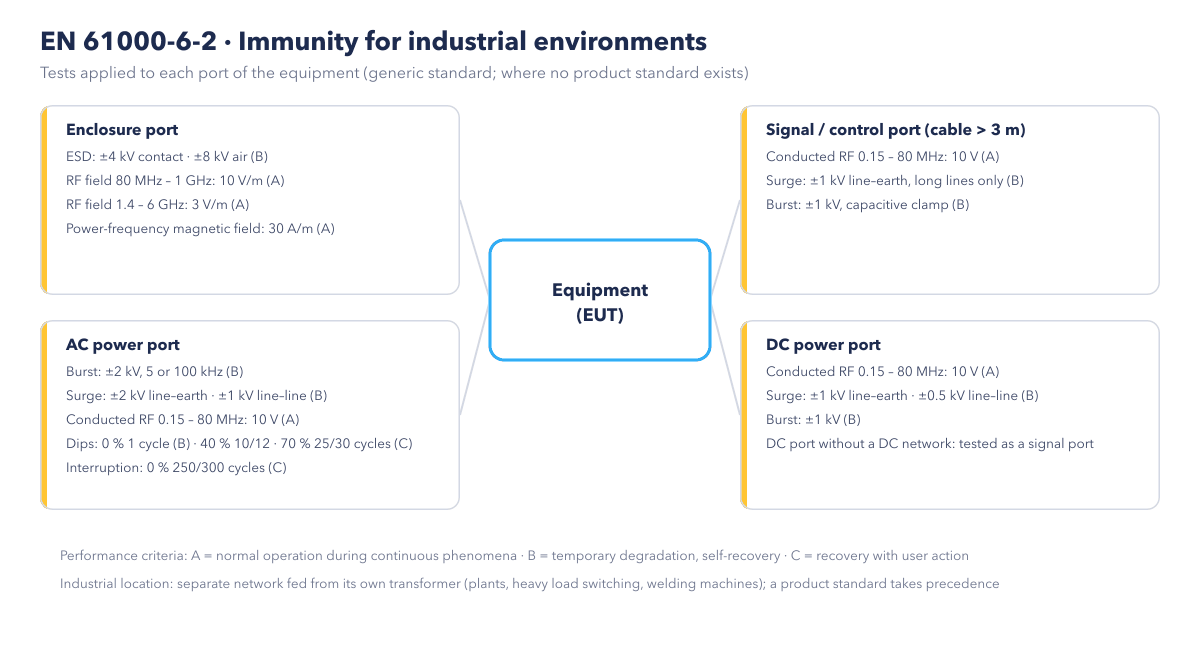
- Enclosure port: electrostatic discharge (EN 61000-4-2), radiated RF field (EN 61000-4-3) and power-frequency magnetic field (EN 61000-4-8). At 30 A/m the magnetic field is ten times the residential level.
- AC power port: burst (EN 61000-4-4), surge (EN 61000-4-5), conducted RF (EN 61000-4-6), voltage dips and interruptions (EN 61000-4-11). For electronic power converters the operation of protective devices and criterion C are accepted.
- DC power port: conducted RF, surge and burst; DC ports not connected to a DC network are tested as signal ports.
- Signal and control ports: conducted RF and burst with the capacitive clamp on connections whose cable may exceed 3 m; surge on long lines leaving the building. Signal ports connected directly to the AC mains are treated as AC power ports.
- Operating condition: the equipment runs in the mode most sensitive to disturbance, with the typical industrial installation defined by the manufacturer.
Test levels
| Phenomenon | Level | Criterion |
|---|---|---|
| Electrostatic discharge | ±4 kV contact · ±8 kV air | B |
| Radiated RF field, 80 MHz – 1 GHz | 10 V/m, 80 % AM 1 kHz | A |
| Radiated RF field, 1.4 – 6 GHz | 3 V/m, 80 % AM 1 kHz | A |
| Power-frequency magnetic field | 30 A/m, 50/60 Hz | A |
| Burst, AC power | ±2 kV, 5 or 100 kHz | B |
| Surge, AC power | ±2 kV line-earth · ±1 kV line-line | B |
| Conducted RF, 0.15 – 80 MHz | 10 V, 80 % AM 1 kHz | A |
| Voltage dips, AC power | 0 % for 1 cycle · 40 % for 10/12 cycles · 70 % for 25/30 cycles | B · C · C |
| Interruption, AC power | 0 % for 250/300 cycles | C |
| Signal port: conducted RF · surge · burst | 10 V · ±1 kV line-earth · ±1 kV | A · B · B |
The levels are those of the 2016 edition. Extreme situations such as the immediate vicinity of welding machines are outside these levels; additional measures are needed there.
Performance criteria
- A: the equipment keeps working within its specified limits during the test. Required for continuous phenomena (RF field, conducted RF, magnetic field).
- B: temporary degradation is allowed; the equipment recovers by itself. Required for transient phenomena (ESD, burst, surge, short dips).
- C: loss of function is allowed; recovery with user action. Accepted for long dips and interruptions.
For industrial equipment the definition of “normal operation” also covers safety functions; the behaviour of the safety function during the test is assessed together with the Low Voltage Directive safety evaluation.
Place in the CE marking process
- It is checked whether a dedicated EMC product standard exists; if not, and the equipment is for industrial use, EN 61000-6-2 is chosen.
- The ports and cable lengths of the equipment are listed; a test plan is made for each port.
- The tests are carried out in an accredited laboratory; the report records the test plan, the criteria and the observed behaviour.
- The report goes into the technical file; the EU Declaration of Conformity under the EMC Directive is drawn up and the product is CE marked.
Standards applied together
- EN 61000-6-4: generic emission standard for the same environment
- EN 61000-6-1: generic immunity for residential and light-industrial environments
- EN 61000-4-2, EN 61000-4-4, EN 61000-4-5: basic test standards for ESD, burst and surge
- EN 61000-4-3, EN 61000-4-6, EN 61000-4-11: basic test standards for RF field, conducted RF and voltage dips
Frequently asked questions
Which standard applies if my product is used both in a factory and in an office?
If conformity is wanted for both environments, the heavier EN 61000-6-2 levels are applied for immunity and the stricter EN 61000-6-3 limits for emission. The equipment is then considered suitable for both environments.
Is EN 61000-6-2 enough for the CE marking of a machine?
Where the electrical equipment of the machine has no product standard, the pair EN 61000-6-2 and EN 61000-6-4 covers the EMC requirements. The EMC conformity of components inside the machine, such as drives and PLCs, is checked separately; the machine-level assessment also covers their installation according to the manufacturer’s instructions.
What if my product fails the 10 V/m test?
Cable screening with 360° chassis bonding, smaller openings in the metal housing and RF filters on analogue inputs usually solve the problem. Sensible filtering of measured values in the firmware also keeps brief deviations within criterion A.
Other standards in this group
- EN 61000-6-4: Generic Emission for Industrial Environments
- EN 61000-6-1: Generic Immunity for Residential and Light-Industrial Environments
- EN 61000-6-3: Generic Emission for Residential and Light-Industrial Environments

