
EN 61000-6-3, “Electromagnetic compatibility (EMC) – Part 6-3: Generic standards – Emission standard for residential, commercial and light-industrial environments”, limits how much electromagnetic noise equipment without a dedicated EMC standard may emit in a residential environment. It is the generic standard on the emission side of EMC testing; its immunity counterpart is EN 61000-6-1.
Let us take care of EN 61000-6-3 measurements and the CE marking of your product together; CE Danışmanı (CE Consultant) manages the whole process.
What is this standard for?
Every electronic device produces some high-frequency noise while operating; it flows along the cables into the mains and radiates from the housing into the air. In a home, radios, televisions and wireless receivers sit right next to the equipment, so the limits are tight. EN 61000-6-3 gives these limits and the measurement method for equipment without a product standard; the aim is to protect radio services.
In the current edition the scope is defined as the residential environment; equipment in commercial and light-industrial locations is assessed with this standard or with EN 61000-6-8. In case of doubt the stricter EN 61000-6-3 applies.
EN 61000-6-3 at a glance
| Current edition | EN IEC 61000-6-3:2021 (CISPR/IEC 61000-6-3:2020); replaces EN 61000-6-3:2007 and its amendments |
|---|---|
| Official title | Electromagnetic compatibility (EMC) – Part 6-3: Generic standards – Emission standard for residential, commercial and light-industrial environments (2021 edition: Emission standard for equipment in residential environments) |
| Type of standard | Generic emission standard: gives the limits itself and refers to the CISPR 16 series for the measurement method |
| Legislation | EMC Directive 2014/30/EU; where no product standard exists, the presumption of conformity is obtained with this standard |
Which products does it apply to?
All electrical and electronic equipment without a dedicated EMC emission standard that is used in homes and in similar locations fed from the public low-voltage network.
- Typical examples: custom control and automation modules, sensor units, chargers, small-series electronic products, hobby and educational equipment.
- The intentional transmissions of radio transmitters and their harmonics are not the subject of this standard; they are assessed under radio equipment legislation.
- Equipment with a product standard, such as household appliances (EN 55014-1), lighting (EN 55015) and multimedia equipment (EN 55032), uses that standard.
Measurements per port
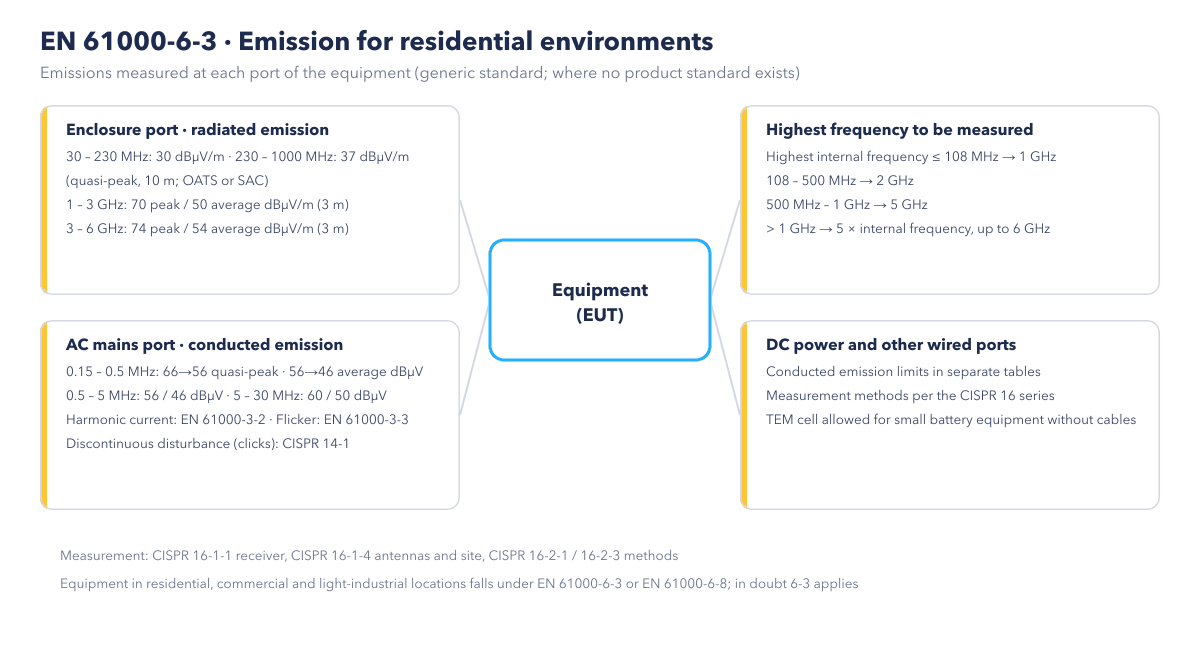
- Enclosure port, radiated emission: the field radiated by the equipment is measured on an open area test site (OATS) or in a semi-anechoic chamber (SAC) at 10 m, from 30 MHz to 1 GHz, with a quasi-peak detector. Above 1 GHz the measurement is made at 3 m with peak and average detectors.
- Highest frequency to measure: depends on the highest internal frequency of the equipment: 1 GHz for up to 108 MHz, 2 GHz for up to 500 MHz, 5 GHz for up to 1 GHz, and above that five times the internal frequency up to 6 GHz.
- AC mains port, conducted emission: the noise on the mains cable is measured from 0.15 to 30 MHz through an artificial mains network (AMN) with quasi-peak and average detectors; discontinuous clicks are assessed to CISPR 14-1.
- Harmonics and flicker: low-frequency emission is also required at the mains port: harmonic current to EN 61000-3-2 or EN 61000-3-12, flicker to EN 61000-3-3 or EN 61000-3-11.
- DC power and other wired ports: separate limit tables apply to conducted emission; for small battery-powered equipment without cables the radiated measurement may also be made in a TEM cell.
Limits
| Port and measurement | Frequency | Limit |
|---|---|---|
| Radiated, 10 m, quasi-peak | 30 – 230 MHz | 30 dBµV/m |
| Radiated, 10 m, quasi-peak | 230 – 1000 MHz | 37 dBµV/m |
| Radiated, 3 m, peak / average | 1 – 3 GHz | 70 / 50 dBµV/m |
| Radiated, 3 m, peak / average | 3 – 6 GHz | 74 / 54 dBµV/m |
| Conducted, AC mains, quasi-peak / average | 0.15 – 0.5 MHz | 66 to 56 / 56 to 46 dBµV (decreasing with frequency) |
| Conducted, AC mains, quasi-peak / average | 0.5 – 5 MHz | 56 / 46 dBµV |
| Conducted, AC mains, quasi-peak / average | 5 – 30 MHz | 60 / 50 dBµV |
Radiated measurements may also be made at 3 m or 5 m, with the limit corrected for the distance. For table-top equipment there are separate limits for the fully anechoic room (FAR) option.
How is compliance assessed?
- The measured value must stay below the limit at the frequency concerned; the result is pass or fail, with no criteria A, B or C as in immunity.
- The equipment is measured in the operating mode producing the highest emission and with the typical cable arrangement defined by the manufacturer.
- Measurement uncertainty is taken into account according to CISPR 16-4-2; the laboratory states its uncertainty in the report.
Place in the CE marking process
- It is checked whether a dedicated EMC product standard exists; if not, EN 61000-6-3 is chosen according to the environment of use.
- The highest internal frequency of the equipment is determined; the upper measurement frequency and the ports are listed.
- The measurements are carried out in an accredited laboratory; the report records the operating mode, the cable arrangement and the measurement distance.
- The report goes into the technical file; the EU Declaration of Conformity under the EMC Directive is drawn up and the product is CE marked.
Standards applied together
- EN 61000-6-1: generic immunity standard for the same environment
- EN 61000-6-4: generic emission for industrial environments
- EN 61000-3-2 and EN 61000-3-3: harmonic current and flicker limits at the mains port
- EN 55014-1, EN 55015, EN 55032: product family emission standards
Frequently asked questions
What is the difference between EN 61000-6-3 and EN 61000-6-4?
Both are emission standards; the difference lies in the environment and the limits. In the residential environment the limits are about 10 dB tighter: radiated emission 30/37 dBµV/m instead of the industrial 40/47 dBµV/m, conducted emission 66/56 instead of 79/73 dBµV. For equipment sold into both environments the 6-3 limits are chosen.
Are measurements made above 1 GHz?
It depends on the highest frequency inside the equipment. For a microcontroller below 108 MHz the measurement ends at 1 GHz; for equipment with a processor above 1 GHz or a wireless module it extends to 6 GHz. This information is given to the laboratory at the quotation stage.
What if my product exceeds the limits?
For conducted emission, a common-mode and differential-mode filter at the mains input; for radiated emission, slower switching edges, cable screening and smaller openings in the housing are the typical solutions. The measurement is then repeated in the same mode.
Other standards in this group
- EN 61000-6-1: Generic Immunity for Residential and Light-Industrial Environments
- EN 61000-6-2: Generic Immunity for Industrial Environments
- EN 61000-6-4: Generic Emission for Industrial Environments

