
EN 61000-3-12, “Electromagnetic compatibility (EMC) – Part 3-12: Limits – Limits for harmonic currents produced by equipment connected to public low-voltage systems with input current > 16 A and ≤ 75 A per phase”, carries the harmonic current limits over to high-current equipment. It continues EN 61000-3-2 on the low-frequency emission side of EMC testing.
Let us take care of EN 61000-3-12 measurements and the CE marking of your product together; CE Danışmanı (CE Consultant) manages the whole process.
What does this test measure?
Motor drives, large power supplies, welding equipment and heat pumps draw a distorted current from the mains; its harmonics heat transformers and distort the voltage. How much depends on the strength of the network: a strong network is affected far less by the same harmonic current. EN 61000-3-12 therefore gives its limits not as a single value but in steps according to the ratio of the network’s short-circuit power to the equipment power, the short-circuit ratio Rsce.
Equipment meeting the limits at Rsce = 33 may be connected at any point of the network; for equipment meeting them only at a higher step, the manufacturer tells the user the minimum Rsce required.
EN 61000-3-12 at a glance
| Current edition | EN 61000-3-12:2011 (IEC 61000-3-12:2011, 2nd edition, replacing the 2004 edition); IEC has published the consolidated Ed. 2.1 with AMD1:2021 |
|---|---|
| Official title | Electromagnetic compatibility (EMC) – Part 3-12: Limits – Limits for harmonic currents produced by equipment connected to public low-voltage systems with input current > 16 A and ≤ 75 A per phase |
| Type of standard | Mains emission standard: it gives the limit tables, the measurement conditions and the user information itself |
| Legislation | EMC Directive 2014/30/EU; the generic emission standard EN 61000-6-3 refers to it for harmonics |
Which products does it apply to?
Equipment connected to the public low-voltage network with a rated input current above 16 A and up to 75 A per phase. The limits are given for 230/400 V, 50 Hz networks; networks up to 240 V single-phase and 690 V three-phase are within the scope.
- Typical products: motor drives with frequency converters, industrial chillers and heat pumps, UPS units, professional welding equipment, commercial kitchen appliances, electric vehicle charging units.
- Equipment connected only to private networks fed at medium or high voltage is outside the scope.
- Equipment above 75 A is assessed under installation-level harmonic rules.
Measurement setup
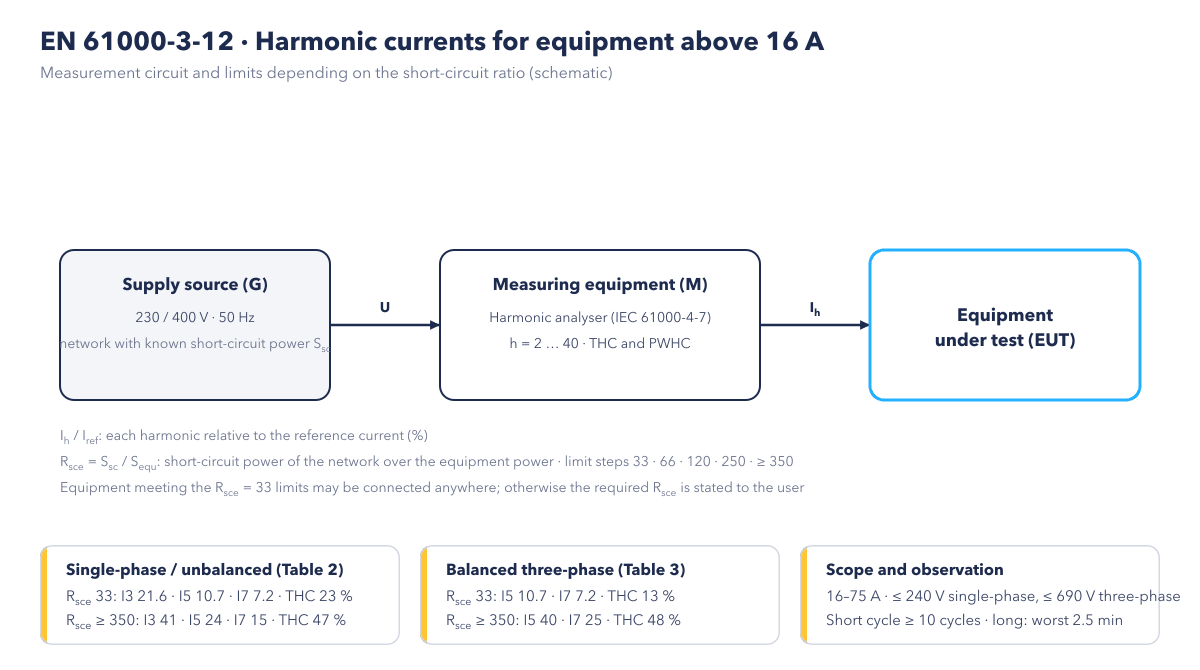
- Supply and measurement: the circuit is the same as for EN 61000-3-2: a clean source, a harmonic analyser to IEC 61000-4-7 and the equipment under test; the 2nd to the 40th harmonic are measured.
- Reference current: the harmonics are assessed not in amperes but as a percentage of the equipment’s reference current, which is derived from the rated current stated by the manufacturer.
- Aggregate quantities: in addition to the individual harmonics, the total harmonic current (THC) and the partial weighted harmonic current (PWHC), which weights the higher orders, are calculated.
- Short-circuit ratio: the Rsce step at which the equipment is assessed is determined; Rsce is calculated with different formulas for single-phase, interphase and three-phase equipment.
- Observation period: as in EN 61000-3-2: at least 10 cycles for cycles up to 2.5 minutes; otherwise the full programme or the worst 2.5 minute segment.
Limits
| Rsce step | Single-phase and unbalanced equipment (Table 2) | Balanced three-phase equipment (Table 3) |
|---|---|---|
| 33 | I5 10.7 % · I7 7.2 % · I3 21.6 % · THC 23 % | I5 10.7 % · I7 7.2 % · THC 13 % · PWHC 22 % |
| 66 | I5 13 % · I7 8 % · THC 26 % | I5 14 % · I7 9 % · THC 16 % |
| 120 | I5 15 % · I7 10 % · THC 30 % | I5 19 % · I7 12 % · THC 22 % |
| 250 | I5 20 % · I7 13 % · THC 40 % | I5 31 % · I7 20 % · THC 37 % |
| ≥ 350 | I5 24 % · I7 15 % · THC 47 % | I5 40 % · I7 25 % · THC 48 % |
The values are percentages of the reference current. Even harmonics up to the 12th order may not exceed 16/h %. For balanced three-phase equipment the more relaxed Tables 4 and 5 may be used where certain conditions are met, such as the phase angle of the 5th and 7th harmonics or a 12-pulse rectifier.
How is compliance assessed?
- The equipment must meet all limits of the chosen Rsce step throughout the observation period; the result is pass or fail.
- No further information is needed for equipment meeting the Rsce = 33 limits. For equipment meeting them at a higher step, the manual states the minimum Rsce required and, where necessary, advises the user to consult the supply authority.
- Hybrid equipment with single-phase and three-phase sections may be measured section by section.
Place in the CE marking process
- The rated current and the type of connection (single-phase, three-phase, hybrid) are determined; the target Rsce step is chosen.
- The DC link reactor, AC line choke or active front end is reviewed during design; a pre-measurement is made if needed.
- The measurement is carried out in an accredited laboratory; the report records the reference current, the Rsce step and the table used.
- The report goes into the technical file; an Rsce statement is added to the manual where required; the EU Declaration of Conformity under the EMC Directive is drawn up and the product is CE marked.
Standards applied together
- EN 61000-3-2: harmonic current limits for equipment up to 16 A
- EN 61000-3-11: flicker and conditional connection for equipment above 16 A
- EN 61000-6-3 and EN 61000-6-4: generic emission for residential and industrial environments
- EN 55011: high-frequency emission of industrial equipment
Frequently asked questions
What is Rsce and why do the limits depend on it?
Rsce is the ratio of the short-circuit power of the network at the point of connection to the rated power of the equipment. The larger the ratio, the stronger the network is relative to the equipment, and the less the same harmonic current distorts the voltage; the standard therefore allows a higher harmonic percentage on strong networks.
What if my product cannot meet Rsce = 33?
The product may still comply: the manufacturer states the Rsce step at which the limits are met, and the user checks, with the supply authority if necessary, that the installation is strong enough. The standard expects this route for most equipment above 16 A.
What if my product exceeds the limits?
A DC link reactor or an AC line choke noticeably reduces the 5th and 7th harmonics; at higher powers a 12-pulse rectifier or an active front end is preferred. The measurement is then repeated in the same mode.
Other standards in this group
- EN 61000-3-3: Voltage Fluctuations and Flicker
- EN 61000-3-11: Flicker for Conditional Connection Equipment
- EN 61000-3-2: Harmonic Current Emissions

