
EN 61000-3-2, “Electromagnetic compatibility (EMC) – Part 3-2: Limits – Limits for harmonic current emissions (equipment input current ≤ 16 A per phase)”, limits how distorted the current drawn by a product from the mains may be. It is one of the two low-frequency emission tests in EMC testing; the other is the flicker measurement (EN 61000-3-3).
Let us take care of EN 61000-3-2 measurements and the CE marking of your product together; CE Danışmanı (CE Consultant) manages the whole process.
What does this test measure?
Equipment with rectifiers and switch-mode power supplies draws a peaked current from the mains rather than a sine wave. The components of this current at multiples of 50 Hz, the harmonics, heat transformers and neutral conductors, distort the mains voltage and disturb other equipment on the same line. The harmonic measurement records the currents from the 2nd to the 40th harmonic and compares them with the limit for the equipment class.
A single product has little effect; the limits assume that thousands of products of the same type are connected to the network at the same time.
EN 61000-3-2 at a glance
| Current edition | IEC 61000-3-2:2018 + A1:2020 + A2:2024; in Europe the series starting with EN 61000-3-2:2014 is applied in its current EN IEC 61000-3-2 edition |
|---|---|
| Official title | Electromagnetic compatibility (EMC) – Part 3-2: Limits – Limits for harmonic current emissions (equipment input current ≤ 16 A per phase) |
| Type of standard | Mains emission standard: it gives the limits and the measurement conditions itself and is applied without a product standard |
| Legislation | EMC Directive 2014/30/EU; the generic emission standard EN 61000-6-3 refers to it |
Which products does it apply to?
All electrical and electronic equipment connected to the public low-voltage network with a rated current of up to 16 A per phase. The standard divides equipment into four classes:
- Class A: everything not in the other classes; balanced three-phase equipment, household appliances, vacuum cleaners, non-portable tools, audio equipment.
- Class B: portable tools and non-professional arc welding equipment.
- Class C: lighting equipment.
- Class D: personal computers, monitors, television receivers and refrigerators with variable-speed compressors, up to 600 W.
No limits are set for equipment of 75 W or less (other than lighting), professional equipment above 1 kW and symmetrically controlled heating elements up to 200 W. Equipment above 16 A per phase falls under EN 61000-3-12.
Measurement setup
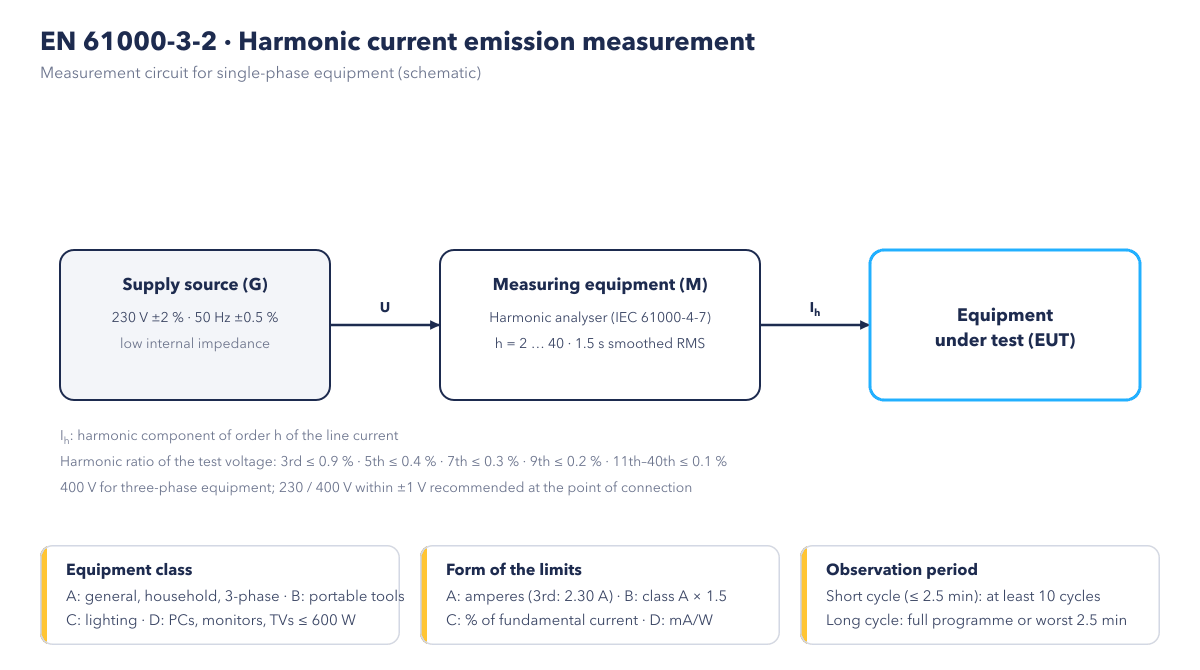
- Supply source: the equipment is fed from a clean source with a low internal impedance: 230 V single-phase or 400 V three-phase, held within 2 % for voltage and 0.5 % for frequency.
- Voltage quality: the source’s own harmonics are limited; the 3rd harmonic may not exceed 0.9 %, the 5th 0.4 %, and the 11th and above 0.1 %. Otherwise it is impossible to tell whether the distortion comes from the equipment or from the source.
- Measuring equipment: a harmonic analyser to IEC 61000-4-7 records the 1.5 s smoothed RMS value of each harmonic.
- Operating condition: the equipment runs in the mode that produces the highest total harmonic current; for lighting the measured power factor enters the limit calculation.
- Observation period: long enough for repeatable results on continuously running equipment; at least 10 cycles for cycles up to 2.5 minutes; the full programme or the worst 2.5 minute segment for longer cycles.
Limits
| Class | Form of the limit | Example |
|---|---|---|
| A | Absolute current per harmonic | 3rd harmonic 2.30 A · 5th 1.14 A · 7th 0.77 A |
| B | 1.5 times the class A values | 3rd harmonic 3.45 A |
| C | Percentage of the fundamental current | 5th harmonic 10 % · 7th 7 % · 3rd 30 × power factor |
| D | Proportional to power (mA/W), capped at the class A values | 3rd harmonic 3.4 mA/W · 5th 1.9 mA/W |
Class C offers separate options for lighting of 25 W and below; the report states which option was used.
How is compliance assessed?
- The 1.5 s values of every harmonic must stay within the limit throughout the observation period; the standard allows a defined margin for brief excursions.
- The equipment is measured under the normal operating conditions defined by the manufacturer; the worst mode is recorded in the report.
- The result is a single pass or fail decision; there are no performance criteria A, B or C for harmonics.
Place in the CE marking process
- The class and the rated power of the equipment are determined; it is checked whether an exemption applies.
- The power factor correction (PFC) circuit or passive filter is reviewed during design; a pre-measurement is made if needed.
- The measurement is carried out in an accredited laboratory; the report records the class, the operating mode and the observation period.
- The report goes into the technical file; the EU Declaration of Conformity under the EMC Directive is drawn up and the product is CE marked.
Standards applied together
- EN 61000-3-3: voltage fluctuation and flicker limits
- EN 61000-3-12: harmonic current limits for equipment above 16 A
- EN 61000-6-3 and EN 61000-6-4: generic emission for residential and industrial environments
- EN 55014-1 and EN 55032: high-frequency emission of household appliances and multimedia equipment
Frequently asked questions
Which class does my product belong to?
Check the class B, C and D definitions first: is it a portable tool, lighting equipment, or a computer or television below 600 W? If none applies, the product is class A. The class changes both the limits and the measurement conditions, so it is written in the report.
Is equipment below 75 W tested?
The standard sets no limits for equipment of 75 W or less other than lighting; no measurement is made, and the standard is only cited in the declaration of conformity. For lighting the threshold is 5 W.
What if my product exceeds the limits?
Active power factor correction is usually added to the power supply, or a passive filter with a series inductor is placed on the input. In low-power products the rectifier capacitor and its charging current are redesigned. The measurement is then repeated in the same mode.
Other standards in this group
- EN 61000-3-11: Flicker for Conditional Connection Equipment
- EN 61000-3-12: Harmonic Currents Above 16 A
- EN 61000-3-3: Voltage Fluctuations and Flicker

