
EN 55014-1, “Electromagnetic compatibility – Requirements for household appliances, electric tools and similar apparatus – Part 1: Emission”, sets the limits and measurement methods for the radio-frequency disturbance these products send into their surroundings. The aim is to protect radio reception and other equipment. The emission side of EMC testing for appliances is done to this standard.
Let us take care of EN 55014-1 testing and the CE marking of your product together; CE Danışmanı (CE Consultant) manages the whole process.
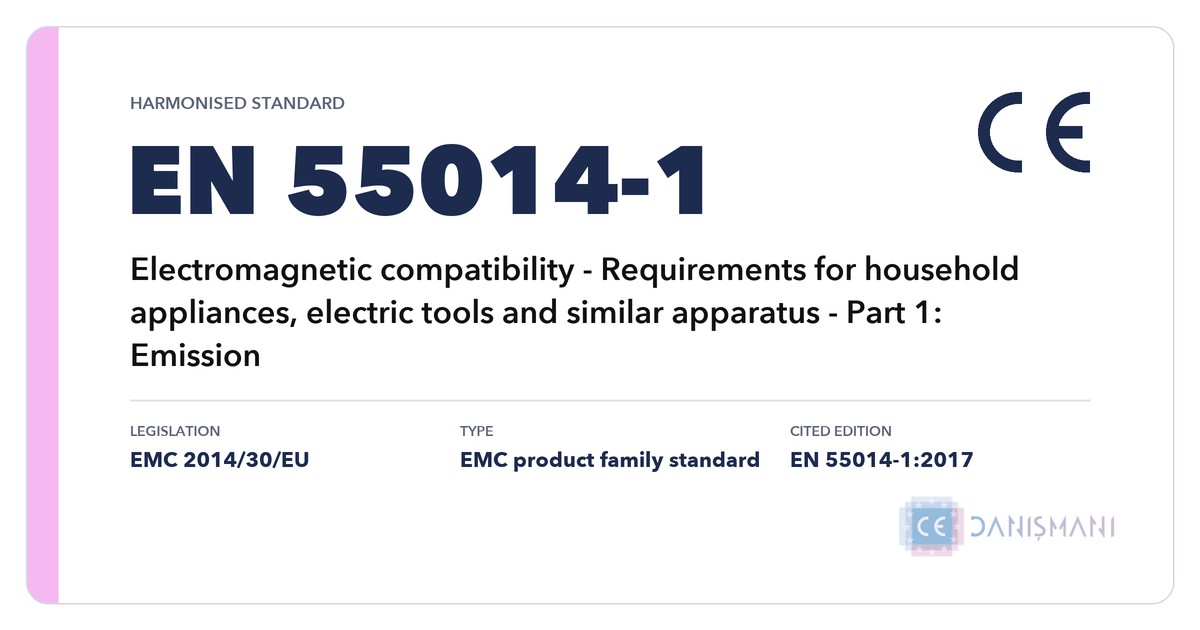
EN 55014-1 at a glance
| Edition cited in the EU Official Journal | EN 55014-1:2017 |
|---|---|
| Official title | Electromagnetic compatibility – Requirements for household appliances, electric tools and similar apparatus – Part 1: Emission |
| Legislation supported | EMC Directive 2014/30/EU |
| Type of standard | EMC product family standard |
Products covered
The standard applies to apparatus whose main functions are performed by motors and by switching or regulating devices. Typical examples:
- Washing machines, dishwashers, refrigerators, vacuum cleaners
- Small appliances such as food processors, blenders and coffee makers
- Electric tools such as drills, grinders and saws
- Heaters, fans, hair dryers
- Electric toys
Lighting equipment falls under EN 55015, multimedia equipment under EN 55032 and microwave ovens under EN 55011. EN 55014-1 deals with emission only; the immunity requirements for the same product family are in EN 55014-2.
Main requirements of the standard
- Limits for continuous disturbance: Limits are given for the steady disturbance from motors, electronic boards and switch mode power supplies.
- Conducted disturbance: Disturbance voltage is measured from 150 kHz to 30 MHz at the mains port and, where present, at load or additional ports.
- Disturbance above 30 MHz: Depending on the product, disturbance power on the supply cord (30 MHz to 300 MHz) or radiated disturbance (30 MHz to 1,000 MHz) is measured.
- Discontinuous disturbance (clicks): Short disturbances produced when thermostats, programme switches and relays operate are assessed under separate rules.
- Limit groups by product type: Different limits apply to household appliances, tools and other product types; for tools the limit depends on motor power.
- Operating conditions: The load, speed setting and programme during measurement are defined for each product type.
EN 55014-1 tests
Measurements are made with the product running in the operating condition defined by the standard, at the setting that gives the highest disturbance.
| Test or check | What is verified? |
|---|---|
| Disturbance voltage at the mains port | Disturbance conducted into the mains is below the limits (measured with an artificial mains network) |
| Disturbance voltage at load and additional ports | Disturbance conducted through auxiliary ports is below the limits |
| Disturbance power | Disturbance that could radiate from the supply cord is below the limits (measured with an absorbing clamp) |
| Radiated disturbance | The field strength radiated by the appliance is below the limits |
| Discontinuous disturbance (click) measurement | The number and amplitude of clicks do not exceed the limit set by the click rate |
| Additional measurements for induction cooking appliances | Conducted disturbance at lower frequencies and the magnetic field are below the limits |
Its place in CE marking
- EMC assessment: The environment, the ports and the applicable emission and immunity standards are identified.
- Design: Filtering, shielding, cable routing and board layout are designed with the emission limits in mind.
- Testing: Emission is measured to EN 55014-1 and immunity to EN 55014-2; harmonics and flicker tests are added.
- Technical file: The test report, set-up photographs and diagrams go into the technical file.
- Declaration of conformity: EN 55014-1 is listed among the standards applied and the CE marking is affixed.
Conformity with a harmonised standard gives presumption of conformity with the corresponding essential requirements of the EMC Directive 2014/30/EU.
Standards applied together
- EN 55014-2: Immunity requirements for household appliances and similar apparatus
- EN IEC 61000-3-2: Limits for harmonic current emissions
- EN 61000-3-3: Limits for voltage fluctuations and flicker
- EN 55032: Emission of multimedia equipment
- EN 55015: Radio disturbance of lighting equipment
- EN 55011: RF disturbance of industrial, scientific and medical equipment
Frequently asked questions
Is an EN 55014-1 test enough on its own?
No. EN 55014-1 covers emission only. EMC conformity also needs immunity (EN 55014-2) and, for mains-connected products, harmonic current and flicker tests.
How is an appliance with Wi-Fi or Bluetooth assessed?
A product with a radio module falls under the Radio Equipment Directive and its EMC is assessed with the standards of that legislation; the laboratory sets the test plan accordingly.
Which edition applies?
The edition cited in the EU Official Journal under the EMC Directive is EN 55014-1:2017. CENELEC has published a newer edition; for presumption of conformity the cited edition counts. Check the current citation before testing starts.

