
EN 60335-2-80, “Household and similar electrical appliances – Safety – Part 2-80: Particular requirements for fans”, sets the safety requirements for electric fans for household and similar use. It is read together with EN IEC 60335-1; Part 2-80 holds the rules that are added or changed for these appliances. Contact with rotating blades, a ceiling fan falling down and a stalled motor are its main subjects.
Let us take care of EN 60335-2-80 testing and the CE marking of your product together; CE Danışmanı (CE Consultant) manages the whole process.
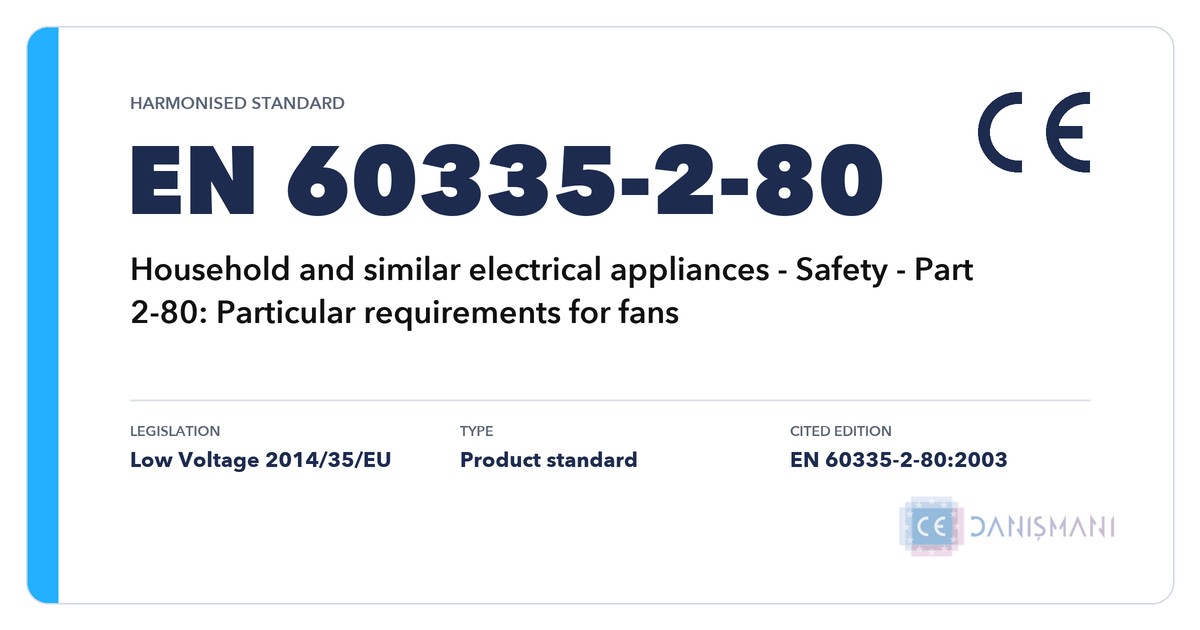
EN 60335-2-80 at a glance
| Edition cited in the EU Official Journal | EN 60335-2-80:2003 |
|---|---|
| Official title | Household and similar electrical appliances – Safety – Part 2-80: Particular requirements for fans |
| Legislation supported | Low Voltage Directive 2014/35/EU |
| Type of standard | Product standard |
Products covered
The standard applies to electric fans used in the home and similar places. Typical examples:
- Table and pedestal fans
- Tower fans
- Ceiling fans, including those with a light
- Wall-mounted fans
- Duct fans and ventilating fans for bathrooms and kitchens
Fans built into another appliance are assessed with the standard for that appliance. Range hoods belong to EN 60335-2-31 and fan heaters to EN 60335-2-30. Fans designed only for industrial purposes are outside this standard.
Particular requirements for fans
- Protection against the blades: Rotating blades must not be reachable with the test finger; the guard must be strong enough and not removable without a tool.
- Ceiling fan suspension: The suspension system must carry a multiple of the weight of the fan without breaking and be secured against loosening by vibration.
- Blade fixing: Blades are fixed so that they cannot come off in operation.
- Locked rotor: When the blade is blocked or the motor cannot turn, the windings must not reach a dangerous temperature.
- Oscillating mechanism and stability: The oscillating head must not trap fingers, and pedestal and table fans must not overturn on a slope.
- Speed controllers and moisture: A speed controller is assessed together with the fan, and fans for bathrooms and kitchens need a suitable degree of protection.
- Installation instructions: The manual covers mounting height and fixing of ceiling fans and, for ventilating fans, precautions against flue gas from fuel-burning appliances being drawn back into the room.
Typical test programme
EN 60335-1 and EN 60335-2-80 are applied together. The programme depends on the type of fan.
| Test or check | What is verified? |
|---|---|
| Power input | The rated input is within the permitted deviation |
| Heating test | Temperatures of the motor winding, cords and body stay within limits |
| Access check with the test finger | Blades and live parts cannot be touched |
| Locked-rotor test | The motor protector operates and the winding temperature limit is not exceeded |
| Suspension load test (ceiling fans) | The suspension system does not break or deform under load |
| Stability and mechanical strength | The fan does not overturn and the guard withstands impact |
| Leakage current and electric strength | Insulation is adequate at operating temperature and after the humidity test |
For fans intended for damp rooms, water spray tests follow the method of IP testing.
Place in the CE marking process
- Risk assessment: Hazards of mechanical injury, falling, electric shock and fire are identified for the type of fan.
- Design: The guard, the suspension system and the motor protection are chosen to meet the standard.
- Verification and testing: The sample is tested to EN 60335-1 and EN 60335-2-80; EMC tests are done separately.
- Technical file: Test reports, diagrams, the list of critical components and the instructions go into the technical file.
- Declaration of conformity: EN 60335-2-80 is listed among the standards applied and the CE marking is affixed.
Compliance with the harmonised standard gives presumption of conformity with the relevant essential requirements of the Low Voltage Directive. Turkey applies the same rules through its own aligned regulation.
Standards applied together
- EN 55014-1 and EN 55014-2: EMC emission and immunity of household appliances
- EN 62233: measurement of electromagnetic fields of household appliances
- EN IEC 60598-1: luminaires, for ceiling fans with a light
- RoHS: restriction of hazardous substances
- Ecodesign rules: efficiency and information requirements for fans are assessed separately where they apply
Frequently asked questions
Is EN 60335-2-80 enough on its own?
No. Part 2-80 is applied together with EN 60335-1 and the test report covers both. EMC, RoHS and other legislation are assessed separately.
Are industrial fans covered?
No. The standard is for household and similar use. Industrial fans are usually assessed under machinery legislation and their own standards.
Which edition applies?
The edition cited in the EU Official Journal is EN 60335-2-80:2003. Check the current citation before testing starts.
Other standards in this group
- EN 60335-2-30: Room Heaters
- EN 60335-2-40: Heat Pumps and Air Conditioners
- EN 60335-2-23: Skin and Hair Care Appliances
- EN IEC 60598-1: Luminaires

