
EN 60335-2-30, “Household and similar electrical appliances – Safety – Part 2-30: Particular requirements for room heaters”, sets the safety requirements for electric room heaters. It is read together with EN IEC 60335-1; Part 2-30 holds the rules that are added or changed for these appliances. Its focus is the risk of fire: a heater that tips over, is covered, or runs close to combustible material.
Let us take care of EN 60335-2-30 testing and the CE marking of your product together; CE Danışmanı (CE Consultant) manages the whole process.
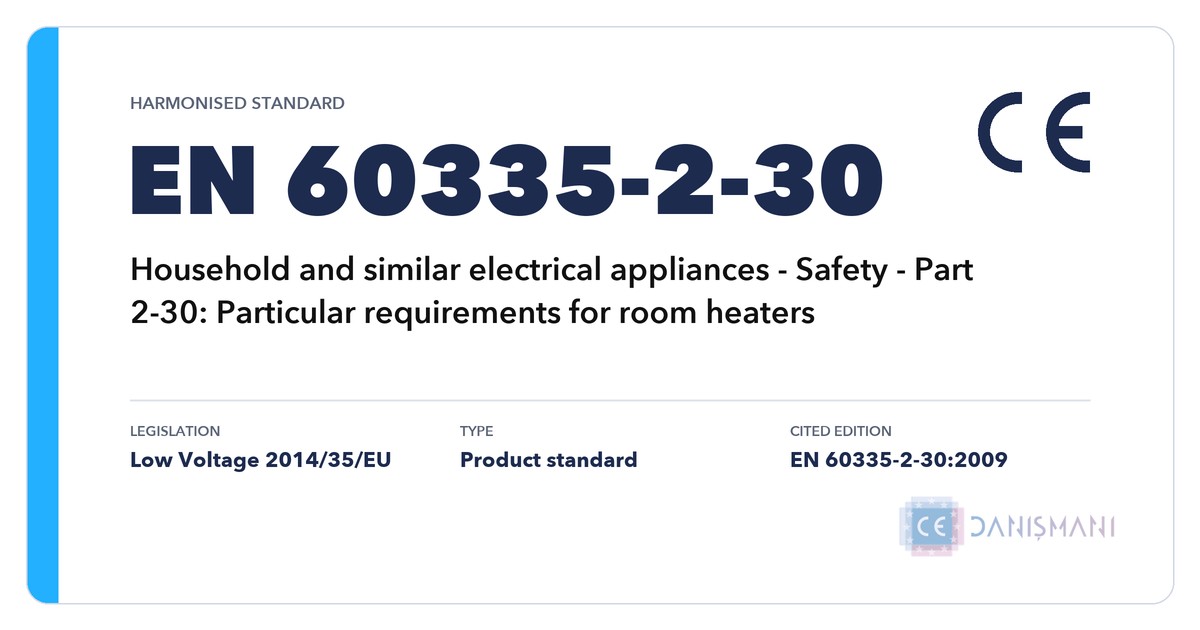
EN 60335-2-30 at a glance
| Edition cited in the EU Official Journal | EN 60335-2-30:2009 |
|---|---|
| Official title | Household and similar electrical appliances – Safety – Part 2-30: Particular requirements for room heaters |
| Legislation supported | Low Voltage Directive 2014/35/EU |
| Type of standard | Product standard |
Products covered
The standard applies to electrical appliances used to heat a room in the home and similar places. Typical examples:
- Fan heaters
- Convectors and panel heaters
- Oil-filled (liquid-filled) radiators
- Quartz, halogen and infrared radiant heaters
- Wall-mounted bathroom heaters and ceiling-mounted heaters
Thermal storage room heaters belong to EN 60335-2-61, electric blankets and heating pads to EN 60335-2-17, and sauna heaters to EN 60335-2-53. Air conditioners and heat pumps are assessed with EN 60335-2-40.
Particular requirements for room heaters
- Tip-over: A portable heater that falls over must not start a fire, whatever position it comes to rest in; this is usually achieved with a tip-over switch or a thermal cut-out.
- Covering: Overheating must not create a hazard when the heater is covered with fabric; the appliance carries the “do not cover” symbol or warning.
- Surface and outlet temperatures: The temperature rise of touchable surfaces, the air outlet grille and the nearby wall and floor is limited.
- Guarding of radiant elements: Visibly glowing heating elements are enclosed by a guard that prevents touching and contact with fabric.
- Fan failure and blocked air flow: The thermal cut-out must operate when the fan stops or the air flow is restricted.
- Stability and liquid-filled radiators: Heaters on feet or castors must not overturn on a slope, and an oil-filled body must not leak or build up dangerous pressure.
- Marking and instructions: The instructions cover distance to curtains and combustible material, not placing the heater below a socket-outlet, use in bathrooms and unattended use.
Typical test programme
EN 60335-1 and EN 60335-2-30 are applied together. Heating tests are run with the appliance placed in a test corner.
| Test or check | What is verified? |
|---|---|
| Power input | The rated input is within the permitted deviation |
| Heating test | Temperatures of surfaces, grille, cords and the walls and floor of the test corner stay within limits |
| Covering test | No ignition or dangerous damage when the heater is covered |
| Tip-over test | A heater running in the overturned position does not cause a fire |
| Abnormal operation | The thermal cut-out opens when the fan stops, the thermostat fails or the air flow is restricted |
| Leakage current and electric strength | Insulation is adequate at operating temperature |
| Resistance to heat and fire | Plastic parts pass the glow-wire and ball pressure tests |
Place in the CE marking process
- Risk assessment: Hazards of fire, burns and electric shock are identified for the type of heater and the place of use.
- Design: The thermal cut-out, the tip-over switch and the guard are chosen to meet the standard.
- Verification and testing: The sample is tested to EN 60335-1 and EN 60335-2-30; EMC tests are done separately.
- Technical file: Test reports, diagrams, the list of critical components and the instructions go into the technical file.
- Declaration of conformity: EN 60335-2-30 is listed among the standards applied and the CE marking is affixed.
Compliance with the harmonised standard gives presumption of conformity with the relevant essential requirements of the Low Voltage Directive. Turkey applies the same rules through its own aligned regulation.
Standards applied together
- EN 55014-1 and EN 55014-2: EMC emission and immunity of household appliances
- EN 62233: measurement of electromagnetic fields of household appliances
- RoHS: restriction of hazardous substances
- Ecodesign rules: efficiency and control features of electric room heaters are assessed separately
Frequently asked questions
Is EN 60335-2-30 enough on its own?
No. Part 2-30 is applied together with EN 60335-1 and the test report covers both. EMC, RoHS and ecodesign are assessed separately.
Is a tip-over switch mandatory?
The standard asks for a result, not a particular component: an overturned heater must not start a fire. Manufacturers usually achieve this with a tip-over switch.
Which edition applies?
The edition cited in the EU Official Journal is EN 60335-2-30:2009. Check the current citation before testing starts.
Other standards in this group
- EN 60335-2-21: Storage Water Heaters
- EN 60335-2-24: Refrigerating Appliances
- EN 60335-2-40: Heat Pumps and Air Conditioners
- EN 60335-2-80: Fans

