
EN ISO 14122-1, “Safety of machinery – Permanent means of access to machinery – Part 1: Choice of fixed means and general requirements of access (ISO 14122-1:2016)”, sets out how operators and maintenance staff reach the points of a machine that cannot be reached from the floor. It answers the question of whether a ramp, stairs or a fixed ladder is to be used. It is the first part of a series; the dimensions of platforms, stairs and guard-rails are in the other parts.
Let us take care of EN ISO 14122-1 testing and the CE marking of your machine together; CE Danışmanı (CE Consultant) manages the whole process.
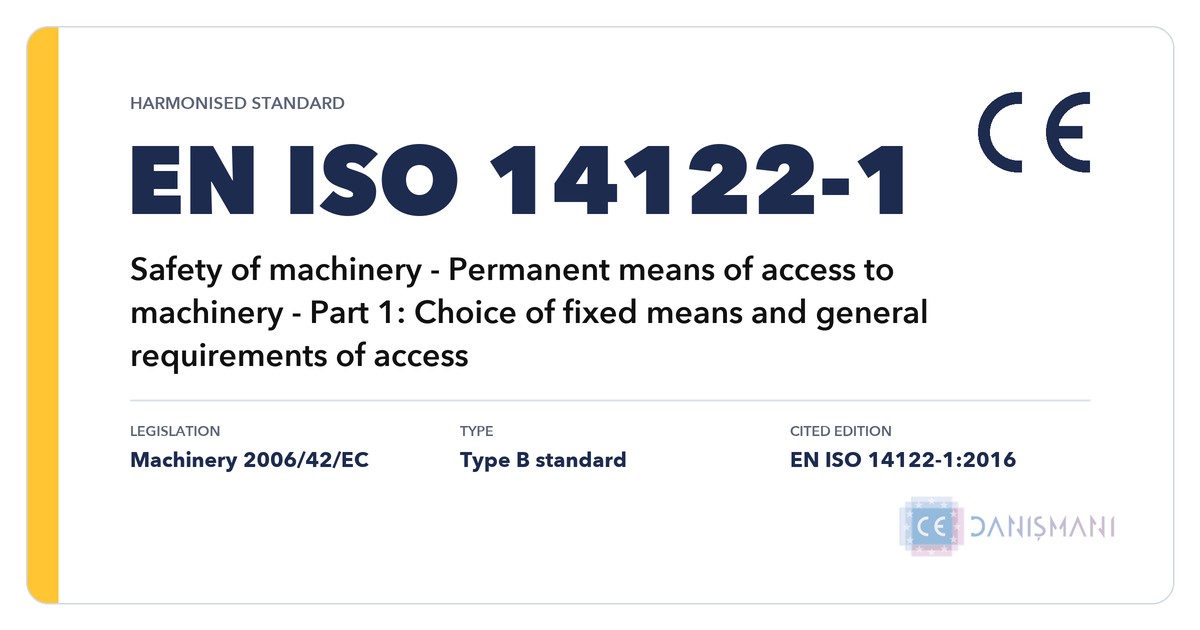
EN ISO 14122-1 at a glance
| Edition cited in the EU Official Journal | EN ISO 14122-1:2016 |
|---|---|
| Official title | Safety of machinery – Permanent means of access to machinery – Part 1: Choice of fixed means and general requirements of access (ISO 14122-1:2016) |
| Legislation supported | Machinery Directive 2006/42/EC; from 20 January 2027 Machinery Regulation (EU) 2023/1230 |
| Type of standard | Type B standard |
Which machines are covered?
The standard applies to machines with operating, setting and maintenance points that cannot be reached from ground level. It covers fixed means of access that are part of the machine; it can also be applied to a part of the building whose main purpose is access to the machine. Typical examples:
- Maintenance platforms of large presses, injection moulding machines and machining centres
- Top access to silos, tanks and mixers
- Crossovers and walkways over conveyor lines
- Operator platforms on packaging and filling lines
- Access ladders of cranes, towers and process equipment
The series has four parts: Part 1 choice and general requirements, Part 2 working platforms and walkways, Part 3 stairs, stepladders and guard-rails, Part 4 fixed ladders. Powered means of access such as lifts, and portable ladders, are outside the series.
Main requirements of the standard
- Reduce the need for access first: Control, setting and maintenance points are placed within reach from ground level where possible.
- Order of preference: If direct access from the floor is not possible, a ramp or stairs come first; a stepladder or fixed ladder is chosen only with a justification.
- Selection criteria: Frequency of access, height, tools or loads carried, number of users and the need for evacuation are considered together.
- Protection against falling: Wherever there is a risk of falling from height, a guard-rail or equivalent protection is provided.
- Slipping and tripping: Walking surfaces are slip-resistant and designed so that water, oil and dirt do not collect.
- Strength: Means of access carry the foreseeable loads and resist corrosion and the environment.
EN ISO 14122-1 verification and checks
Verification is by design review, visual inspection and measurement on the machine. Details of strength and dimensional checks come from the relevant part of the series.
| Test or check | What is verified? |
|---|---|
| Review of access points | All points that have to be reached for operation, setting and maintenance are identified |
| Justification of the choice | Where a ladder is chosen instead of a ramp or stairs, the reason is recorded |
| Fall protection | Guard-rails and protection at access openings are complete |
| Walking surfaces | Surfaces are slip-resistant, do not collect liquids and have no trip points |
| Evidence of strength | Calculation or test shows that platforms, stairs and guard-rails carry the foreseeable loads |
Means of access are often completed on site during installation, so the final check is made after the machine has been erected.
Its place in the CE marking process
- Risk assessment: The points that cannot be reached from the floor and how often they are accessed are identified under EN ISO 12100.
- Design: The type of access is chosen to EN ISO 14122-1; dimensions come from the relevant part of the series.
- Verification: The means of access are inspected and measured on the machine.
- Technical file: The access plan, the justification, drawings and inspection records go into the technical file.
- Declaration of conformity: EN ISO 14122-1 is listed among the standards applied.
Conformity with a harmonised standard gives presumption of conformity with the relevant essential requirements of the machinery legislation. Turkey applies the same rules through its own regulation aligned with 2006/42/EC. See also CE marking of machinery.
Standards applied together
- EN ISO 14122-3: Stairs, stepladders and guard-rails
- EN ISO 14122-2 and EN ISO 14122-4: Working platforms, walkways and fixed ladders
- EN ISO 13857: Safety distances from access routes to hazard zones
- EN ISO 14120: Fixed and movable guards
- EN ISO 20607: Preparing the instruction handbook
Frequently asked questions
Can a fixed ladder always be used?
No. The standard prefers access from the floor, then a ramp or stairs. A ladder may be chosen for a reason such as lack of space or infrequent access, and that reason is recorded.
Where do I find the dimensions?
Part 1 gives the choice and the general requirements. Dimensions of platforms, stairs, guard-rails and fixed ladders are in Parts 2, 3 and 4.
Which edition applies?
The edition cited in the EU Official Journal is EN ISO 14122-1:2016. Check the current citation before testing starts.
Other standards in this group
- EN ISO 4414: Pneumatic Fluid Power Safety
- EN ISO 13854: Minimum Gaps to Avoid Crushing
- EN ISO 14122-3: Stairs Stepladders and Guard-Rails
- EN ISO 20607: Machinery Instruction Handbook

