
EN IEC 62031, “LED modules for general lighting – Safety specifications”, sets the safety rules for LED modules used as light sources in lighting. Electric shock, heating, fault conditions, fire and the effect of the light on the eye are assessed with it. It is the basis of LVD testing for companies that make modules or build them into luminaires.
Let us take care of EN IEC 62031 testing and the CE marking of your product together; CE Danışmanı (CE Consultant) manages the whole process.
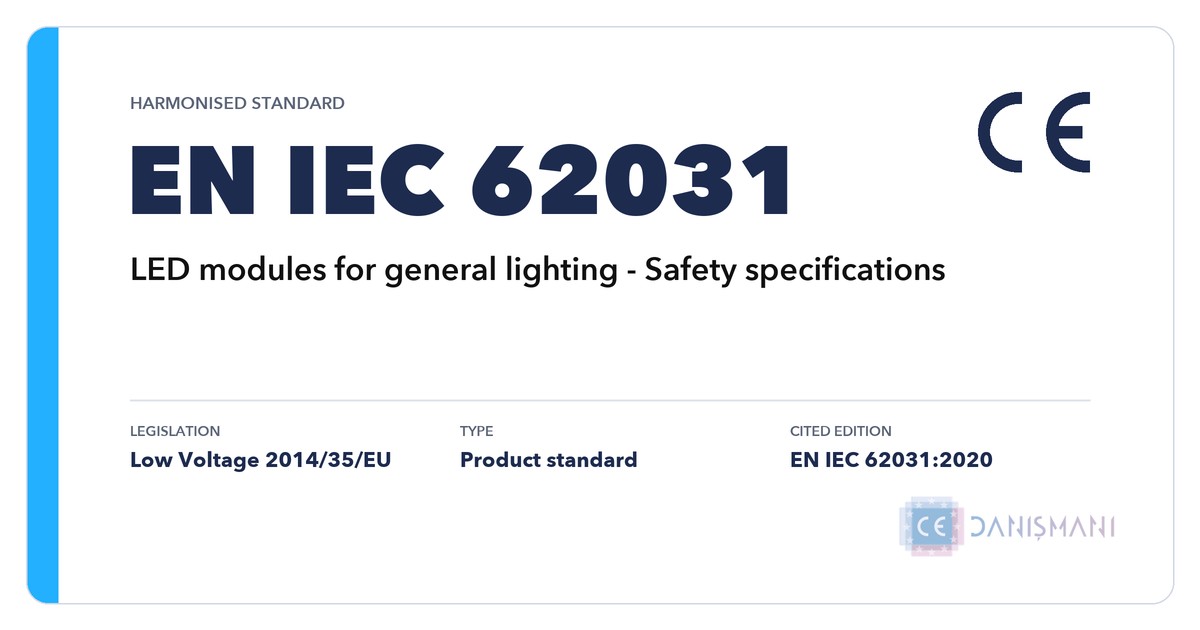
EN IEC 62031 at a glance
| Edition cited in the EU Official Journal | EN IEC 62031:2020 |
|---|---|
| Official title | LED modules for general lighting – Safety specifications |
| Legislation supported | Low Voltage Directive 2014/35/EU |
| Type of standard | Product standard |
Products covered
The standard covers LED modules for general lighting. A module can be of the type with separate controlgear (fed at constant voltage, constant current or constant power) or of the type with integrated controlgear connected directly to the mains. Three types are distinguished by the way they are mounted:
- Built-in modules, designed to be fitted inside a luminaire or an enclosure
- Independent modules, which can be mounted separately from a luminaire
- Integral modules, which form a non-replaceable part of a luminaire
- Strip, panel and linear LED modules
- Mains-voltage LED modules with integrated controlgear
LED lamps with caps are not covered here; they have their own lamp standards. A separate LED driver is assessed to EN 61347-1 and EN 61347-2-13, and the luminaire that holds the module to EN IEC 60598-1.
Main requirements of the standard
- Marking: Rated voltage or current, power, the point of maximum permitted operating temperature and the module type are given on the product or in its documents.
- Terminals: Terminals and connecting means must give a safe and lasting connection.
- Protection against contact with live parts: Depending on the module type, access to live parts is prevented or this protection is left to the luminaire.
- Moisture resistance and insulation: Insulation resistance and electric strength must be adequate after humidity conditioning.
- Fault conditions: Faults such as a short-circuited or open component must not produce flame, molten material or hazardous voltage.
- Construction and insulation distances: Clearances, creepage distances and mechanical construction must suit the working voltage.
- Resistance to heat, fire and tracking: Insulating parts must resist heat, ignition and tracking.
EN IEC 62031 tests
The tests are type tests on samples. For built-in and integral modules some tests are completed with the module fitted in the luminaire.
| Test or check | What is verified? |
|---|---|
| Marking check | The required information is legible and durable |
| Insulation resistance and electric strength | The insulation is adequate after humidity conditioning |
| Fault condition tests | The module causes no hazard under a single fault |
| Temperature measurement | The declared maximum temperature at the reference point on the module is not exceeded |
| Measurement of insulation distances | Clearances and creepage distances are sufficient |
| Heat and ignition tests | The insulating material resists heat and flame |
| Photobiological assessment | The risk group for blue light hazard is determined |
Its place in CE marking
- Risk assessment: Hazards are identified and the applicable standards selected.
- Design: The module is designed to EN IEC 62031; the controlgear and luminaire conditions it is meant for are defined.
- Verification tests: Type tests are carried out on samples and reported.
- Technical file: Diagrams, the parts list and the test report go into the technical file.
- Declaration of conformity: EN IEC 62031 is listed among the standards applied and the CE marking is affixed.
Conformity with a harmonised standard gives presumption of conformity with the corresponding safety objectives of the Low Voltage Directive 2014/35/EU. For mains-connected modules, radio disturbance is also measured to EN 55015.
Standards applied together
- EN IEC 60598-1: Luminaires, general requirements and tests
- EN 61347-1: Lamp controlgear, general and safety requirements
- EN 61347-2-13: Electronic controlgear for LED modules
- EN 62471: Photobiological safety of lamps and lamp systems
- EN 55015: Radio disturbance of lighting equipment
- EN 62717: Performance requirements for LED modules
Frequently asked questions
Does a module inside a luminaire need separate testing?
The luminaire is assessed to EN IEC 60598-1, and conformity of the module to EN IEC 62031 is an input to that assessment. Using a module with documented conformity makes luminaire testing simpler.
Is the LED driver covered by this standard?
Separate drivers follow the EN 61347 series. Where the controlgear is on the module, the module is assessed to EN IEC 62031 together with it.
Which edition applies?
The edition cited in the EU Official Journal under the Low Voltage Directive is EN IEC 62031:2020. Check the current citation before testing starts.
Other standards in this group
- EN IEC 62040-1: Uninterruptible Power Systems
- EN IEC 61558-1: Transformers and Power Supply Units
- EN 61347-1: Lamp Controlgear
- EN 62477-1: Power Electronic Converters

