
EN 62477-1, “Safety requirements for power electronic converter systems and equipment – Part 1: General”, sets the common safety rules for rectifiers, inverters and similar power electronic converters. Electric shock, energy, fire, thermal and mechanical hazards are assessed with it. For converters without a product standard of their own, LVD testing is carried out directly to this standard.
Let us take care of EN 62477-1 testing and the CE marking of your product together; CE Danışmanı (CE Consultant) manages the whole process.
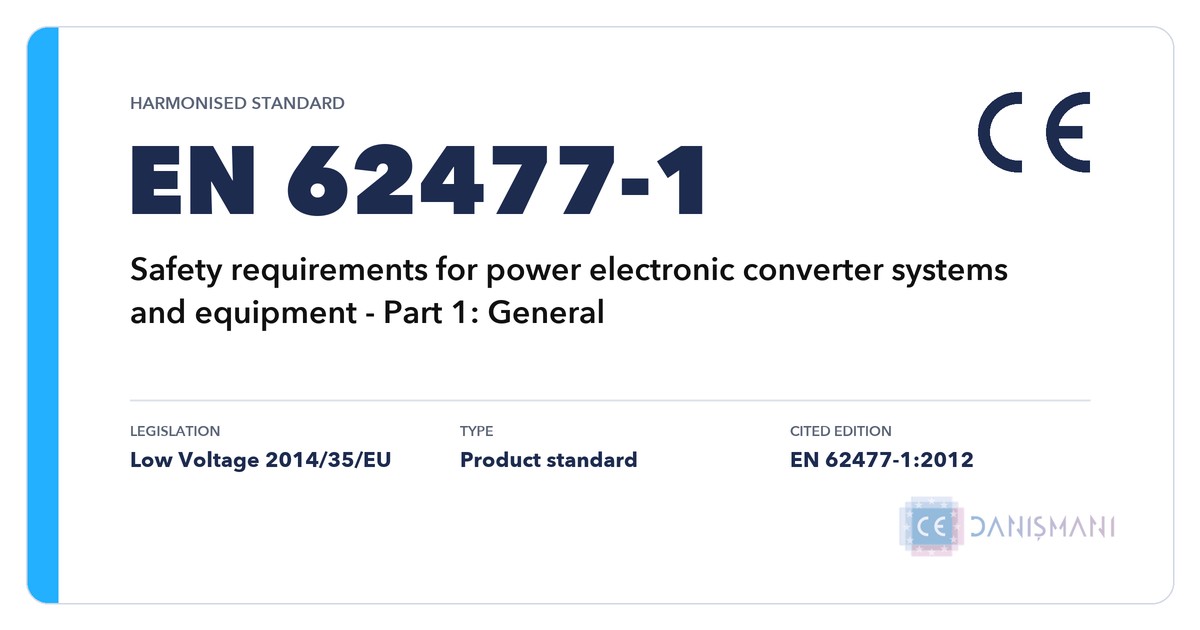
EN 62477-1 at a glance
| Edition cited in the EU Official Journal | EN 62477-1:2012 |
|---|---|
| Official title | Safety requirements for power electronic converter systems and equipment – Part 1: General |
| Legislation supported | Low Voltage Directive 2014/35/EU |
| Type of standard | Product standard |
| Voltage limit | Converter systems with a rated system voltage not exceeding 1,000 V AC or 1,500 V DC |
Products covered
The standard applies to systems that convert electrical energy with power semiconductors, and to their components. It also gives a common safety basis to the committees that write product standards for particular converter types. Typical examples:
- Rectifiers and industrial battery chargers
- Inverters and DC/DC converters
- Power converters of energy storage systems
- Active filters and static compensation equipment
Where a product group has its own safety standard, that standard takes precedence. Adjustable speed drives follow EN 61800-5-1, uninterruptible power systems EN IEC 62040-1 and photovoltaic inverters EN 62109-1; some of these use EN 62477-1 as their reference.
Main requirements of the standard
- Protection against electric shock: Circuits are assigned to decisive voltage classes (DVC); basic protection, fault protection and the insulation needed are set for each class.
- Insulation coordination: Clearances, creepage distances and solid insulation are sized by voltage, overvoltage category and pollution degree.
- Protective earthing and bonding: Accessible conductive parts are reliably connected to the protective conductor and touch current is limited.
- Energy hazards: Discharge of the charge stored in capacitors and short circuit of high-current circuits are considered.
- Fire and thermal hazards: Parts must not overheat in normal operation or under fault, and the enclosure must prevent the spread of fire.
- Short-circuit and fault behaviour: The converter must cause no hazard under the declared short-circuit conditions and under component faults.
EN 62477-1 tests
The standard defines three kinds of test: type tests that verify the design, routine tests on every unit produced, and sample tests on units taken at intervals.
| Test or check | What is verified? |
|---|---|
| Dielectric tests | The insulation is adequate under impulse voltage and AC or DC withstand voltage |
| Protective bonding test | The earthing circuit is continuous and of sufficiently low impedance |
| Touch current measurement | The current through accessible parts stays at a permitted level |
| Heating test | Parts and accessible surfaces stay within the permitted temperatures |
| Short-circuit and fault tests | No hazard arises from an output short circuit, a component fault or loss of cooling |
| Capacitor discharge test | After disconnection, the voltage on accessible parts falls to a safe level |
| Enclosure and environmental tests | IP degree of protection, mechanical strength and resistance to climatic conditions |
Its place in CE marking
- Risk assessment: Hazards are identified and the applicable standards selected.
- Design: The converter is designed to EN 62477-1; the voltage classes of circuits and the insulation levels are fixed.
- Verification tests: Type tests are carried out on a sample and routine tests on every unit.
- Technical file: Diagrams, the parts list and the test report go into the technical file.
- Declaration of conformity: EN 62477-1 is listed among the standards applied and the CE marking is affixed.
Conformity with a harmonised standard gives presumption of conformity with the corresponding safety objectives of the Low Voltage Directive 2014/35/EU. Converters are also subject to EMC; for industrial products emission is mostly measured to EN 55011.
Standards applied together
- EN IEC 62040-1: Uninterruptible power systems
- EN 61800-5-1: Safety of adjustable speed electrical power drive systems
- EN 62109-1: Safety of power converters for use in photovoltaic power systems
- EN 60664-1: Insulation coordination in low-voltage systems
- EN 60204-1: Electrical equipment of machines
- EN 55011: RF disturbance of industrial equipment
Frequently asked questions
Does EN 62477-1 or another standard apply to my product?
First check whether the product group has its own safety standard. If it has, that standard applies; if not, EN 62477-1 is used directly.
What is a decisive voltage class (DVC)?
It is the class given to a circuit according to its working voltage. The class decides whether the circuit may be touched and which insulation is needed between it and neighbouring circuits.
Which edition applies?
The edition cited in the EU Official Journal under the Low Voltage Directive is EN 62477-1:2012. Check the current citation before testing starts.
Other standards in this group
- EN IEC 62031: LED Modules
- EN 61347-1: Lamp Controlgear
- EN 60335-2-15: Appliances for Heating Liquids
- EN 60335-2-21: Storage Water Heaters

