
EN ISO 16092-1, “Machine tools safety – Presses – Part 1: General safety requirements (ISO 16092-1:2017)”, is the type C standard with the safety requirements common to all presses that work cold metal. The most serious hazard is crushing of hands and arms between the closing tools. This part gives the common rules; the rules specific to mechanical, hydraulic and pneumatic presses are in the other parts of the series, and the two are applied together.
Let us take care of EN ISO 16092-1 testing and the CE marking of your machine together; CE Danışmanı (CE Consultant) manages the whole process.
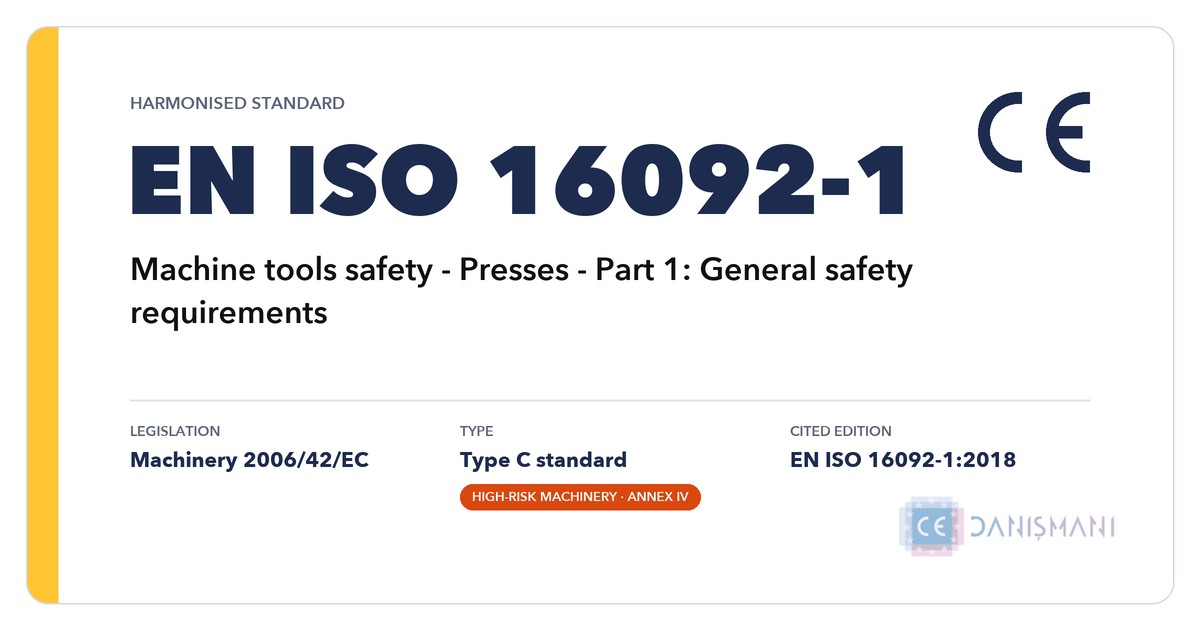
EN ISO 16092-1 at a glance
| Edition cited in the EU Official Journal | EN ISO 16092-1:2018 |
|---|---|
| Official title | Machine tools safety – Presses – Part 1: General safety requirements (ISO 16092-1:2017) |
| Legislation supported | Machinery Directive 2006/42/EC; from 20 January 2027 Machinery Regulation (EU) 2023/1230 |
| Type of standard | Type C standard |
| Risk category | On the high-risk machinery list: presses for the cold working of metals with manual loading or unloading (2006/42/EC Annex IV, item 9) |
Which machines does it cover?
The standard covers presses that work cold metal, or material partly made of cold metal, with tools, together with their feeding and removal devices. Typical examples:
- Eccentric and servo-driven mechanical presses (with Part 2)
- Hydraulic presses (with Part 3)
- Pneumatic presses (with Part 4)
- Press lines fed by decoilers, feeders and transfer devices
Press brakes are outside the series; hydraulic press brakes are dealt with in EN 12622.
Main requirements of the standard
- Safeguarding the tool area: Access to the tools is prevented by a method chosen for the kind of production: closed tools, fixed guards, interlocking movable guards, light curtains or two-hand control.
- Interlocking guards: The closing movement cannot start with the guard open; where needed the guard stays locked until the dangerous movement has ended.
- Light curtains: The protective device is placed at a distance calculated from the stopping time of the press, and standing behind it is prevented.
- Two-hand control: Each operator has a separate control device, placed where the hands cannot reach the danger zone in time.
- Modes of operation: Setting, single stroke and continuous modes are selected with a lockable selector.
- Control system: Functions that start and stop the stroke are redundant and monitored; a single fault must not cause an unintended stroke.
- Protection against falling of the slide: A mechanical restraint or equivalent holds the slide during maintenance and tool change.
- Monitoring of stopping performance: If the stopping performance degrades, a new stroke is prevented.
Verification and tests under EN ISO 16092-1
For each requirement the standard names the verification method: visual inspection, measurement, functional test or review of documents.
| Test or check | What is verified? |
|---|---|
| Visual inspection | Guards, control devices and marking are complete |
| Stopping time measurement | Stopping performance of the slide and the safety distances that depend on it |
| Functional test of guards and interlocks | The stroke stops and does not restart when a guard is opened or the light curtain is interrupted |
| Two-hand control test | Synchronous actuation, stop on release and conditions for restart |
| Review of the control system | Redundancy, monitoring and fault simulation on the diagrams |
Results are recorded in the test report. Safety functions are validated with EN ISO 13849-2.
Where it fits in CE marking
- Risk assessment: The hazards of the press and its feeding equipment are identified under EN ISO 12100.
- Design: The safeguarding method and control architecture are designed to this part and to the part for the press type.
- Verification: Stopping time measurement and functional tests are carried out on the machine.
- Technical file: Risk assessment, diagrams, calculations and the test report go into the technical file.
- Declaration of conformity: EN ISO 16092-1 is listed among the standards applied.
Conformity with a harmonised standard gives presumption of conformity with the essential requirements it covers; see CE marking of machinery.
Standards applied together
- EN ISO 16092-2, -3 and -4: requirements specific to mechanical, hydraulic and pneumatic presses
- EN ISO 14119: interlocking devices associated with guards
- EN ISO 13855: positioning of safeguards with respect to approach speed
- EN ISO 13851: two-hand control devices
- EN ISO 13849-1 and EN 60204-1: control system and electrical equipment
Frequently asked questions
Is Part 1 enough on its own?
No. The general requirements are applied together with the part for the drive type of the press; both appear in the declaration of conformity.
Does every press need a light curtain?
No. The standard accepts several safeguarding methods; the choice depends on the production, the tools and the way of feeding.
Which edition applies?
The edition cited in the EU Official Journal is EN ISO 16092-1:2018. The current citation should be checked before testing starts.
Other standards in this group
- EN 12417: Machining Centres
- EN 12622: Hydraulic Press Brakes
- EN ISO 23125: Turning Machines
- EN ISO 10218-1: Industrial Robots

