
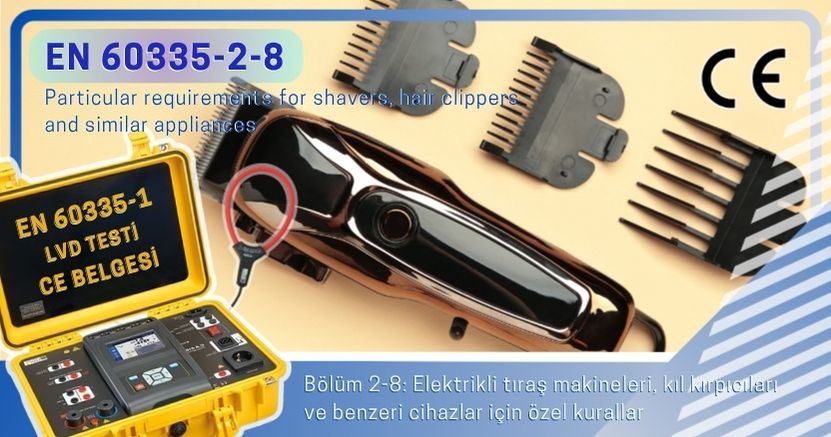
EN 60335-2-8, “Household and similar electrical appliances – Safety – Part 2-8: Particular requirements for shavers, hair clippers and similar appliances”, sets the safety requirements for electric shavers, hair clippers, beard trimmers, nose and ear trimmers, epilators and similar personal care cutting appliances. It covers both corded and rechargeable models, is applied under the Low Voltage Directive 2014/35/EU and is read together with EN IEC 60335-1.
For EN 60335-2-8 testing and CE marking of your shaver or clipper, apply to CE Danışmanı (CE Consultant); we manage the whole process for you.
EN 60335-2-8 at a glance
| Edition cited in the EU Official Journal (LVD list) | EN 60335-2-8:2015+A1:2016+A11:2017 |
|---|---|
| Newer CENELEC edition | EN IEC 60335-2-8:2022 |
| Related legislation | LVD 2014/35/EU, EMC 2014/30/EU, RED 2014/53/EU, RoHS 2011/65/EU |
| Scope | Household electric shavers, hair clippers, trimmers, epilators and similar appliances |
The edition cited in the Official Journal is the one that gives presumption of conformity with the Low Voltage Directive. Confirm the cited edition with the laboratory before testing starts.
Why shavers have their own standard
A shaver works with sharp blades that rotate or oscillate a fraction of a millimetre from the skin. Skin contact, water, battery voltage and a fast motor create three basic risks:
- Cuts and injury: blade design and guarding are critical.
- Electric shock: the user holds the appliance with wet hands.
- Thermal runaway of the battery: especially in lithium rechargeable models.
The standard distinguishes sharply between appliances that may be used wet, in the shower or under water, and those for dry use only. Corded models used in a bathroom need additional insulation, usually a safety isolating transformer that reduces the voltage.
Products covered
- Rotary and foil shavers
- Wet and dry shavers
- Corded shavers supplied through a safety transformer
- Rechargeable shavers (lithium-ion or NiMH)
- Hair clippers, beard and moustache trimmers
- Epilators with rotating discs
- Nose and ear trimmers, body groomers
Products not covered
- Hair straighteners, curling tongs and heated wax epilators: EN 60335-2-23 (appliances for skin or hair care)
- Light-based (IPL) hair removal devices: assessed with EN 60335-2-23 and EN 60335-2-27, and checked against the medical device rules
- Electric toothbrushes: EN 60335-2-52
- Industrial and veterinary clippers: separate sector standards
Particular requirements for shavers and clippers
- Clause 22, blade guard. The foil or cutting head must not come off unintentionally, so that the user cannot reach the cutting parts in normal use. The instructions should say when the foil has to be replaced.
- Clause 15, wet use (IPX7). If the appliance is declared suitable for wet use, it must remain electrically safe after temporary immersion: 1 m under water for 30 minutes, followed by a function and insulation check. Dry-only models are IPX0 or IPX4.
- Clause 22, charging unit. The charging stand or USB charger must not catch fire under short circuit. The instructions must warn against charging in the bathroom, because the adapter itself is not protected against water.
- Battery protection. A lithium-ion battery must not catch fire or explode under overcharge, short circuit, drop or crush. This is verified together with EN 62133-2.
- Clause 11, heating. The temperature rise of the parts that touch the skin, such as the handle and the area around the head, is limited so that the skin cannot be burned.
- Clause 25, supply cord. Pull and flexing tests on corded models.
Typical test programme
- Construction: Class II or Class III; rechargeable models are normally Class III, supplied at safety extra-low voltage.
- Electrical: electric strength (1000 V to 3000 V depending on the class), insulation resistance, leakage current.
- Heating: continuous operation with a full battery and during charging, motor winding temperature.
- Mechanical: drop test, force needed to pull off the cutting head, cord flexing.
- Water (IPX7): 1 m immersion for 30 minutes, then operation and insulation resistance.
- Battery (EN 62133-2): overcharge, short circuit, impact, crush, temperature cycling.
- EMC: EN 55014-1 and EN 55014-2.
The charger and adapter
The adapter supplied in the box is a product in its own right. It must have its own conformity evidence to EN 62368-1, and that evidence belongs in the technical file of the shaver; a statement such as “compatible USB adapter” is not enough. If no adapter is supplied, only a USB cable, the instructions must specify the adapter the user should use, for example 5 V, 2 A.
Other legislation that applies
- EMC 2014/30/EU
- Radio Equipment Directive 2014/53/EU for models with Bluetooth or another radio function
- RoHS 2011/65/EU and REACH, including limits for nickel release from plated parts in contact with the skin
Frequently asked questions
Is an epilator covered by the same standard as a shaver?
Yes. EN 60335-2-8 covers epilators with the same guarding, battery and water tests. A heated wax epilator is different and belongs to EN 60335-2-23.
What is the difference between a wet and dry shaver and a dry-only shaver?
The wet and dry model is tested to IPX7, which is far more demanding. The enclosure must be completely sealed, usually with double O-rings and an ultrasonically welded housing.
From testing to CE marking
- Scope analysis. Confirm that EN 60335-2-8 is the right Part 2 for the product and list the other legislation that applies.
- Document review. Circuit diagrams, parts list, certificates of critical components and user instructions are checked before the sample goes to the laboratory.
- Testing. EN 60335-1 and EN 60335-2-8 together, plus EMC tests to EN 55014-1 and EN 55014-2, and EN 62133-2 for rechargeable models.
- Technical file and declaration. The technical file includes the risk analysis and the test reports; the EU Declaration of Conformity lists every directive and standard applied.
- CE marking. The mark is at least 5 mm high. The technical file is kept for 10 years.
A report from an accredited laboratory is what market surveillance authorities and distributors usually ask to see. Turkey applies the same rules through its own regulation aligned with 2014/35/EU, and the documents of imported products are checked through TAREKS. Send every variant (voltage, colour, options) to the laboratory together, because models added later need extra testing.

