
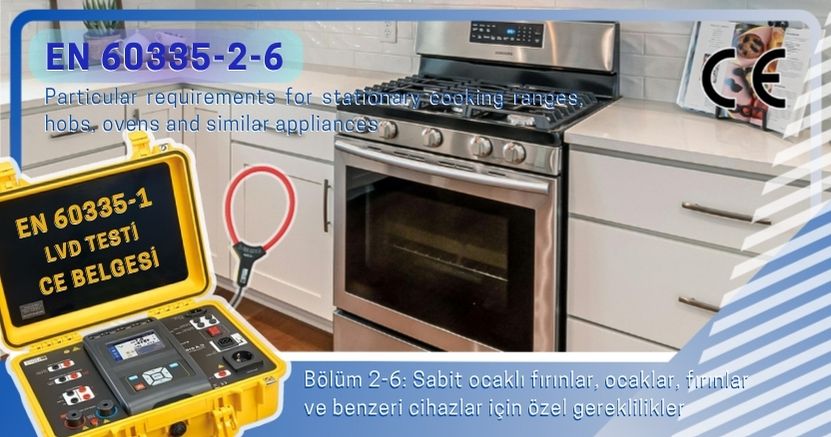
EN 60335-2-6, “Household and similar electrical appliances – Safety – Part 2-6: Particular requirements for stationary cooking ranges, hobs, ovens and similar appliances”, sets the safety requirements for electric ovens, hobs and their combinations that are installed in a fixed position in the home. It covers built-in and standalone cookers, separate hobs, steam ovens and ovens with pyrolytic self-cleaning. It is applied under the Low Voltage Directive 2014/35/EU and is read together with EN IEC 60335-1.
For EN 60335-2-6 testing and CE marking of your oven or hob, apply to CE Danışmanı (CE Consultant); we manage the whole process for you.
EN 60335-2-6 at a glance
| Edition cited in the EU Official Journal (LVD list) | EN 60335-2-6:2015+A11:2020+A1:2020 |
|---|---|
| Newer CENELEC edition | EN 60335-2-6:2015+A11:2020+A1:2020+A2:2023 |
| Related legislation | LVD 2014/35/EU, EMC 2014/30/EU, Ecodesign (EU) No 66/2014, Energy Labelling (EU) No 65/2014, RoHS 2011/65/EU |
| Scope | Household stationary ovens, built-in hobs, cooking ranges and similar cooking appliances |
The edition cited in the Official Journal is the one that gives presumption of conformity with the Low Voltage Directive. Confirm the cited edition with the laboratory before testing starts.
Why cooking appliances have their own standard
A cooker carries a high electrical load (3 to 10 kW), reaches very high temperatures (around 500 °C inside a pyrolytic oven) and runs for long periods. A small insulation fault, a loose terminal or a failed thermostat can turn into a kitchen fire. The standard concentrates on:
- safe connection at high power, single-phase or three-phase
- limits on the temperature of accessible surfaces, with children in mind
- strength of the door glass at pyrolytic temperatures
- spillage on the hob and automatic switch-off
- safe behaviour of the controls after a fault, such as an unintended start or a broken sensor
Induction hobs have additional tests: pan detection, automatic switch-off and human exposure to the magnetic field (EN 62233).
Products covered
- Built-in electric ovens and standalone cookers with oven and hob
- Built-in electric hobs: ceramic, induction, solid plate, touch control
- Pyrolytic and catalytic self-cleaning ovens
- Steam ovens
- Multi-function cooking columns and ovens with telescopic runners
Products not covered
- Portable table-top hobs, grills and ovens: EN 60335-2-9
- Microwave ovens: EN 60335-2-25
- Range hoods: EN 60335-2-31
- Gas ovens and hobs: EN 30-1-1 series
- Commercial ovens for bakeries and restaurants: EN 60335-2-36
Particular requirements for stationary cooking appliances
- Clause 11, accessible surface temperature. The temperature rise of the outer door surface and other touchable parts is limited during cooking, and the same limits apply in pyrolytic mode.
- Clause 21, door glass. The door, with double or triple glazing, must keep its outer pane cool while the cavity is at pyrolytic temperature, pass the impact test and survive repeated opening and closing.
- Clause 15, spillage on the hob. Water or food boiling over must not enter the controls, cause an electrical fault or start uncontrolled heating.
- Clause 22, pyrolytic door lock. The door stays locked during pyrolytic cleaning and until the cavity has cooled to a safe temperature.
- Clause 22, induction pan detection. A zone must not heat when a small or unsuitable metal object, such as a spoon or a key, is placed on it.
- Clause 22, time limit. A hob zone left on must switch off automatically.
- Clause 22, child lock. Touch controls offer a lock mode, typically a long press or a key combination.
- Clause 25, supply connection. Rules for the terminal block: screw torque, conductor cross-section and insulation.
- Clause 20, stability. A standalone cooker must not tip with the door open and loaded; telescopic runners must carry the load when fully extended.
Typical test programme
- Construction: Class I with earthing, earth continuity below 0.1 Ω, protection of the hob surface and the terminal box against water.
- Electrical: electric strength, insulation resistance, leakage current.
- Heating: oven at maximum temperature in conventional and pyrolytic mode, hob at maximum power, mapping of outer surface temperatures. Built-in models are tested installed in a kitchen cabinet.
- Mechanical: door endurance, glass impact test, shelf load, telescopic runner endurance.
- Abnormal operation: thermostat failed in the heating state, open sensor, fan failure, door lock disabled in pyrolytic mode.
- Induction: magnetic field measurement to EN 62233, pan detection, wrong-pan detection.
- EMC: EN 55014-1 and EN 55014-2, with wide-band emission measurements for induction hobs.
Other legislation that applies
- Ecodesign (EU) No 66/2014 and Energy Labelling (EU) No 65/2014 for ovens, with performance measured to EN 60350-1 (ovens) and EN 60350-2 (hobs)
- EMC 2014/30/EU and RoHS 2011/65/EU
- Radio Equipment Directive 2014/53/EU for Wi-Fi models: EN 300 328, EN 301 489, EN 62311, and EN 18031-1 for cybersecurity from August 2025. Remote start needs an additional risk assessment because the user is not next to the appliance.
- Food contact rules for surfaces that touch food
From testing to CE marking
- Scope analysis. Confirm that EN 60335-2-6 is the right Part 2 for the product and list the other legislation that applies.
- Document review. Circuit diagrams, parts list, certificates of critical components and user instructions are checked before the sample goes to the laboratory.
- Testing. EN 60335-1 and EN 60335-2-6 together, plus EMC tests to EN 55014-1 and EN 55014-2, EN 62233 for induction hobs and EN 60350 performance measurements.
- Technical file and declaration. The technical file includes the risk analysis and the test reports; the EU Declaration of Conformity lists every directive and standard applied.
- CE marking. The mark is at least 5 mm high. The technical file is kept for 10 years.
A report from an accredited laboratory is what market surveillance authorities and distributors usually ask to see. Turkey applies the same rules through its own regulation aligned with 2014/35/EU, and the documents of imported products are checked through TAREKS. Send every variant (voltage, colour, options) to the laboratory together, because models added later need extra testing. The technical file of a cooker also holds the high-current and control circuit diagrams, the certificate of the door glass and the induction coil specification.

