
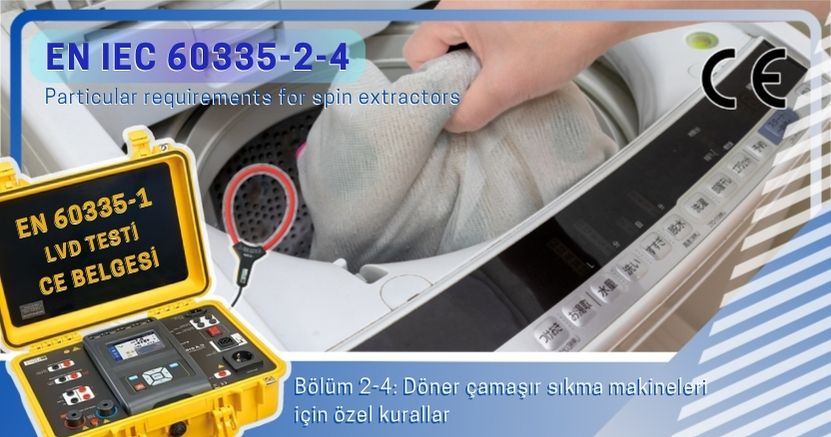
EN 60335-2-4, “Household and similar electrical appliances – Safety – Part 2-4: Particular requirements for spin extractors”, sets the safety requirements for household spin extractors, the standalone appliances that remove water from washed laundry by spinning it at high speed. Because the drum stores a large amount of kinetic energy, the standard deals with electrical and mechanical safety together. It is applied under the Low Voltage Directive 2014/35/EU and is read together with EN IEC 60335-1.
For EN 60335-2-4 testing and CE marking of your spin extractor, apply to CE Danışmanı (CE Consultant); we manage the whole process for you.
EN 60335-2-4 at a glance
| Edition cited in the EU Official Journal (LVD list) | EN 60335-2-4:2010+A1:2015+A11:2018+A2:2019 |
|---|---|
| Newer CENELEC edition | EN IEC 60335-2-4:2023 |
| Related legislation | LVD 2014/35/EU, EMC 2014/30/EU, RoHS 2011/65/EU |
| Scope | Standalone household spin extractors with a capacity of up to about 10 kg of laundry |
The edition cited in the Official Journal is the one that gives presumption of conformity with the Low Voltage Directive. Confirm the cited edition with the laboratory before testing starts.
Why spin extractors have their own standard
A spin extractor runs its drum at roughly 1400 to 2800 rpm. At that speed an unbalanced load, a worn bearing or an open lid can cause serious injury. On the electrical side the motor draws a high starting current, needs braking, and works next to water, so sealing matters. The standard concentrates on three points:
- Lid interlock. The lid cannot be opened while the drum is turning.
- Out-of-balance control. The appliance slows down or stops when vibration becomes excessive.
- Insulation against water. The motor and the control electronics are protected against splashing and leaking water.
Products covered
- Standalone, single-function spin extractors
- Top-loading spin extractors
- Models with manual or automatic out-of-balance control
- Models that drain through a pump
Capacity makes no difference: a 2 kg compact model and an 8 kg model are tested to the same standard, with test loads scaled to the declared capacity.
Products not covered
- Washing machines with a spin function: EN 60335-2-7
- Tumble dryers that dry with heat (vented, condenser, heat pump) and the drying function of washer-dryers: EN 60335-2-11
- Commercial and laundry-scale centrifuges: machinery legislation and the related standards apply
The category chosen by the manufacturer must be stated clearly in the Declaration of Conformity.
Particular requirements for spin extractors
- Clause 20, lid interlock. The lid must not open while the motor is running. After the motor is switched off, the interlock must hold until the drum has slowed to below 60 rpm, the speed chosen as the threshold below which a hand reaching in is no longer at serious risk.
- Clause 20, braking. When the user asks to open the lid, the drum must be brought down to that speed quickly.
- Clause 20, out-of-balance load. The appliance must reduce speed or stop when vibration is excessive. The test is repeated five times with a deliberately unbalanced load, and the protection must work each time.
- Clause 21, drum strength. The drum is run above its rated speed and must neither burst nor throw off parts. The standard does not prescribe the drum material; it requires adequate mechanical strength and corrosion resistance, and stainless steel is the usual choice.
- Clause 15, moisture resistance. The drain pump, the bearing area and the motor air passages must be protected against water.
- Clause 19, locked motor. Power is applied with the drum blocked; the thermal protection must operate.
Typical test programme
- Construction: appliance class, earthing, protection against water with the lid closed.
- Electrical: electric strength, insulation resistance, leakage current (up to 3.5 mA for stationary Class I motor appliances).
- Heating: motor at rated load in continuous and intermittent operation, winding temperature against the limit of its insulation class.
- Mechanical: five out-of-balance runs, endurance of the lid interlock, drum overspeed test.
- Water: leakage with the pump blocked, a detached hose, and the security of electrical connections under vibration.
- EMC: EN 55014-1 and EN 55014-2.
Technical file contents specific to this product
- Drum material report, bearing specification and motor data sheet
- Circuit diagram and the specification of the lid lock solenoid
- Mechanical risk assessment: moving parts, sharp edges, ejected parts
Machinery legislation
Household appliances intended for domestic use fall under the LVD and not under the machinery legislation. If the spin extractor is intended for semi-commercial use, the machinery rules apply as well and the risk assessment and CE marking are extended accordingly. See the Machinery Regulation (EU) 2023/1230.
In Turkey the CE marking is required for the domestic market as well as for export. A TSE mark is a separate quality mark and does not replace it. There is no separate EU energy label for spin extractors.
From testing to CE marking
- Scope analysis. Confirm that EN 60335-2-4 is the right Part 2 for the product and list the other legislation that applies.
- Document review. Circuit diagrams, parts list, certificates of critical components and user instructions are checked before the sample goes to the laboratory.
- Testing. EN 60335-1 and EN 60335-2-4 together, plus EMC tests to EN 55014-1 and EN 55014-2.
- Technical file and declaration. The technical file includes the risk analysis and the test reports; the EU Declaration of Conformity lists every directive and standard applied.
- CE marking. The mark is at least 5 mm high. The technical file is kept for 10 years.
A report from an accredited laboratory is what market surveillance authorities and distributors usually ask to see. Turkey applies the same rules through its own regulation aligned with 2014/35/EU, and the documents of imported products are checked through TAREKS. Send every variant (voltage, colour, options) to the laboratory together, because models added later need extra testing.

