
EN IEC 62040-1, “Uninterruptible power systems (UPS) – Part 1: Safety requirements”, sets the rules a UPS must meet to be safe for users, service personnel and the installation. Electric shock, energy hazards, fire, heating and battery-related risks are assessed with this standard. LVD testing of a UPS is carried out to it.
Let us take care of EN IEC 62040-1 testing and the CE marking of your product together; CE Danışmanı (CE Consultant) manages the whole process.
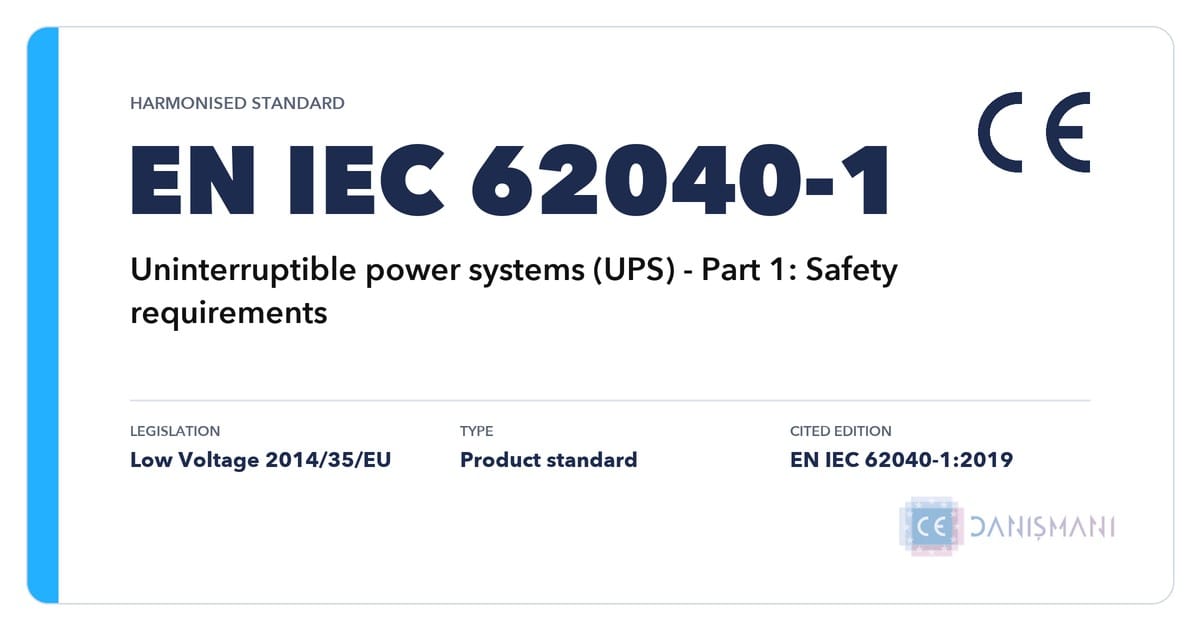
EN IEC 62040-1 at a glance
| Edition cited in the EU Official Journal | EN IEC 62040-1:2019 |
|---|---|
| Official title | Uninterruptible power systems (UPS) – Part 1: Safety requirements |
| Legislation supported | Low Voltage Directive 2014/35/EU |
| Type of standard | Product standard |
Products covered
The standard applies to UPS that contain an energy storage device, usually a battery, to keep supplying the load when the mains fails, and that are used in low-voltage distribution systems. Movable, stationary and built-in types are included. Typical examples:
- Small UPS for offices and homes
- UPS for server rooms and data centres
- Three-phase UPS systems for industrial sites
- Modular and parallel UPS systems
- UPS with external battery cabinets
This edition uses EN 62477-1, the general safety standard for power electronic converters, as its reference and adds the rules specific to UPS. Electromagnetic compatibility of UPS is dealt with separately in EN IEC 62040-2.
Main requirements of the standard
- Protection against electric shock: Access to live parts is prevented; insulation, protective earthing and separation between circuits are provided.
- Backfeed protection: A hazardous voltage must not appear on the input terminals of the UPS when the mains has failed.
- Energy hazards: Short circuit and discharge of stored energy sources such as batteries and capacitors are considered.
- Battery safety: Ventilation of the battery compartment, electrolyte leakage, overcharging and protection of the battery circuit are assessed.
- Heating and fire: Parts must not overheat and fire must not spread, in normal operation and under fault conditions.
- Mechanical safety: Stability, enclosure strength, moving parts such as fans, and handling means are covered.
- Clearances and creepage distances: Distances are set according to voltage, overvoltage category and pollution degree.
- Marking and instructions: Ratings, warning labels and instructions for installation and battery replacement are supplied.
EN IEC 62040-1 tests
The tests are type tests on a sample; some are run in normal operation and some under single-fault conditions.
| Test or check | What is verified? |
|---|---|
| Input and output ratings | Declared current and power values agree with the measured values |
| Heating test | Parts and accessible surfaces stay within the permitted temperatures |
| Dielectric strength and insulation | Insulation between circuits and to earth is adequate |
| Touch current and protective earthing | No hazardous current on accessible parts; the earth connection is continuous |
| Backfeed protection test | The input terminals carry no hazardous voltage when the mains is absent |
| Abnormal operation and fault tests | No hazard arises from component failure, overload, short circuit or a stalled fan |
| Enclosure tests | Mechanical strength and the declared IP degree of protection |
Its place in CE marking
- Risk assessment: Hazards are identified and the applicable standards selected.
- Design: The UPS is designed to EN IEC 62040-1 and its reference EN 62477-1; batteries and critical components are selected to their own standards.
- Verification tests: Safety tests are carried out on a sample and reported.
- Technical file: Diagrams, the parts list and the test report go into the technical file.
- Declaration of conformity: EN IEC 62040-1 is listed among the standards applied and the CE marking is affixed.
Conformity with a harmonised standard gives presumption of conformity with the corresponding safety objectives of the Low Voltage Directive 2014/35/EU. A UPS also falls under the EMC Directive; emission and immunity are tested separately to EN IEC 62040-2.
Standards applied together
- EN 62477-1: Safety of power electronic converter systems
- EN IEC 62040-2: Electromagnetic compatibility requirements for UPS
- EN IEC 62040-3: Method of specifying the performance and test requirements of UPS
- EN 62368-1: Audio/video and ICT equipment
- EN IEC 62485-2: Safety of stationary battery installations
Frequently asked questions
Why does backfeed protection matter?
If the UPS feeds voltage back to its input through the inverter while the mains is off, a person working on a line believed to be dead can receive a shock. The standard therefore asks for isolation of the input or an equivalent measure.
Is safety testing enough for a UPS?
No. CE marking also needs EMC testing, and the product is subject to the restriction of hazardous substances (RoHS).
Which edition applies?
The edition cited in the EU Official Journal under the Low Voltage Directive is EN IEC 62040-1:2019. Check the current citation before testing starts.
Other standards in this group
- EN 61439-1: Low-Voltage Switchgear Assemblies General Rules
- EN 61439-2: Power Switchgear and Controlgear Assemblies
- EN IEC 61558-1: Transformers and Power Supply Units
- EN IEC 62031: LED Modules

