
EN 60335-2-10, “Household and similar electrical appliances – Safety – Part 2-10: Particular requirements for floor treatment machines and wet scrubbing machines”, sets the safety requirements for household floor polishers, floor scrubbers, carpet shampooers and similar floor care appliances. It is the main standard for showing conformity with the Low Voltage Directive 2014/35/EU for these products and is read together with EN IEC 60335-1.
For EN 60335-2-10 testing and CE marking of your floor care appliance, apply to CE Danışmanı (CE Consultant); we manage the whole process for you.
EN 60335-2-10 at a glance
| Edition cited in the EU Official Journal (LVD list) | EN 60335-2-10:2003+A1:2008 |
|---|---|
| Newer CENELEC edition | EN IEC 60335-2-10:2022 |
| Related legislation | LVD 2014/35/EU, EMC 2014/30/EU, RoHS 2011/65/EU |
| Scope | Household floor treatment machines (polishing, waxing) and wet scrubbing machines (floor scrubbers, carpet and upholstery shampooers) |
The edition cited in the Official Journal is the one that gives presumption of conformity with the Low Voltage Directive. Confirm the cited edition with the laboratory before testing starts.
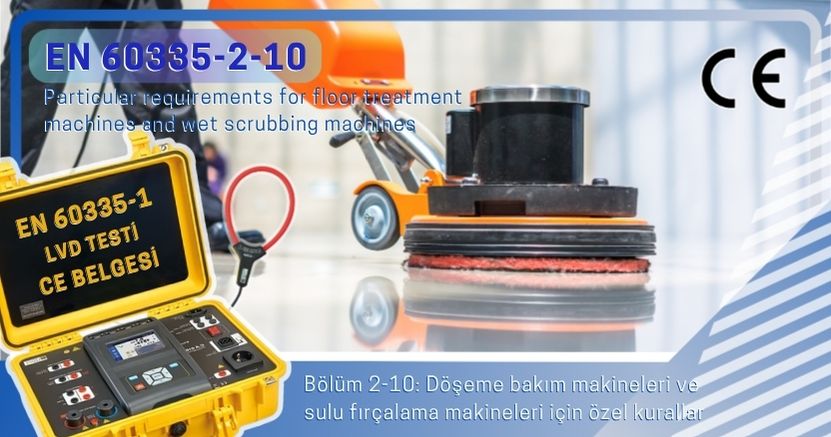
Why floor treatment machines have their own standard
These appliances have one of the more complex risk profiles among household products, because several hazards are present at once:
- Electricity and water. The appliance uses water on purpose, and if it leaks the user is standing on a wet floor.
- Rotating parts. Brushes, pads and rollers.
- The supply cord. The user pulls the machine around by hand, and the cord can be drawn into the rotating brush.
For polishers with a rotating pad there is a further problem: a machine put down while it is running can catch the user’s foot or the cord.
Products covered
- Floor washing machines with one tank or with separate clean and dirty water tanks
- Floor scrubbers with rotating brushes
- Parquet polishing and buffing machines
- Floor waxers and polish applicators
- Carpet shampooers with an extraction system
- Portable household scrubbers for tiled floors
- Robotic floor washers with a battery and charging dock
Products not covered
- Dry vacuum cleaners: EN 60335-2-2
- Commercial and industrial floor cleaning machines: EN 60335-2-67 and EN 60335-2-72
- High-pressure cleaners: EN 60335-2-79
- Industrial cleaning robots: machinery legislation
Appliances that clean with steam are generally assessed to a different Part 2 standard. The laboratory confirms the classification before testing starts.
Which standard for a wet and dry cleaner?
The primary function decides. A model that cleans dry and can occasionally be used wet with an accessory belongs to EN 60335-2-2. A model designed around wet cleaning, with a tank, a mop or roller and wet pick-up, belongs to EN 60335-2-10. Combination models are often tested to both standards.
Particular requirements for floor treatment machines
- Clause 15, moisture resistance. The appliance must withstand splashing water from all directions (IPX4).
- Clause 20, rotating brush guard. Neither a finger nor an object such as the cord may reach the rotating surface of the brush; a foot guard or brush cover is needed.
- Clause 22, insulation after wet operation. After the appliance has been used with water in the normal way, it must still pass the electric strength and insulation resistance tests.
- Clause 25, cord routing. The supply cord must be attached to the body so that it cannot enter the path of the brush, for example with internal routing or a clip. The brush must not cut the cord even when the user is careless.
- Clause 11, handle temperature. The temperature rise of the handle and grip is limited.
- Clause 19, abnormal operation. Blocked brush, empty tank, and failure of the water level sensing in models that fill or empty automatically.
Typical test programme
- Construction: Class II (double insulation) is the more common choice; Class I is also possible.
- Electrical: electric strength, insulation resistance and leakage current, in normal and wet conditions.
- Heating: continuous operation with a full tank at the highest setting.
- IP test: IPX4 splash test.
- Mechanical: access to the rotating brush with test probes and objects, stability test.
- EMC: EN 55014-1 and EN 55014-2.
A carpet shampooer differs from a plain floor washer because it also sucks the dirty water back. This hydraulic path has its own checks (tank separation, no cross-contamination), so two models of the same manufacturer need two test reports.
Robotic floor washers
The robot is assessed to EN 60335-2-10 and the dock is assessed separately as a Class I or Class II appliance. If the dock fills clean water and drains dirty water automatically, that hydraulic design is tested too, including failure of the level sensor. The lithium battery is tested to EN 62133-2, and a Wi-Fi module brings in the Radio Equipment Directive 2014/53/EU.
Machinery legislation
Small household models that are carried in one hand are normally covered by the LVD and EN 60335-2-10 alone. For large, heavy models close to commercial use, the machinery rules can apply as well. Interpretations differ, so this should be settled with the laboratory before testing. See the Machinery Regulation (EU) 2023/1230.
From testing to CE marking
- Scope analysis. Confirm that EN 60335-2-10 is the right Part 2 for the product and list the other legislation that applies.
- Document review. Circuit diagrams, parts list, certificates of critical components and user instructions are checked before the sample goes to the laboratory.
- Testing. EN 60335-1 and EN 60335-2-10 together, plus EMC tests to EN 55014-1 and EN 55014-2, and EN 62133-2 for battery models.
- Technical file and declaration. The technical file includes the risk analysis and the test reports; the EU Declaration of Conformity lists every directive and standard applied.
- CE marking. The mark is at least 5 mm high. The technical file is kept for 10 years.
A report from an accredited laboratory is what market surveillance authorities and distributors usually ask to see. Turkey applies the same rules through its own regulation aligned with 2014/35/EU, and the documents of imported products are checked through TAREKS. Send every variant (voltage, colour, options) to the laboratory together, because models added later need extra testing. The technical file also holds the motor specification, brush or pad drawings, tank specification and the IP test evidence.

